News and articles
- Home
- Articles






Latest posts

A preschool teacher works with children aged one to six years and is responsible for stimulating their learning and development through play, educational activities, and social interaction. The profession involves planning, implementing, and evaluating activities based on the preschool curriculum. Preschool teachers often collaborate with colleagues, child carers, and guardians to create a safe and developmental environment. The work environment is dynamic, involving both physical activity and creative problem-solving, requiring flexibility, patience, and good communication skills.
Read more ->
A preschool psychologist works to promote children's mental health and development in preschool settings. Tasks include assessments of children's needs, consultation and guidance for staff and guardians, preventive efforts, and early support measures. The role also involves collaboration with other professionals in student health, such as special educators and counselors, and often includes work both on an individual and group level. The work environment is varied and can include both individual consultations and work at different preschools, where flexibility and the ability to work independently are important qualities.
Read more ->-

Opinion Polls: Kantar-Sifo shows increased support for S, decline for SD and C
Fri, 13 Feb 2026 - 01:35 -

Policy rate remains at 1.75% – Riksbank signals stability
Thu, 29 Jan 2026 - 14:02


A preschool consultant works to support and develop operations within preschools, often commissioned by municipalities or larger educational organizations. Tasks include guiding preschool staff, developing pedagogical methods, quality follow-up, and advising on laws and guidelines. The preschool consultant also acts as a link between preschool staff and management, helping to ensure that operations meet national and local goals. The work is primarily office-based but also involves regular visits to various preschools and participation in networks and training sessions.
Read more ->
A preschool assistant works to support preschool teachers and childcare workers in daily activities at the preschool. Tasks often include assisting during meals, play, and educational activities, as well as creating a safe and stimulating environment for children. Preschool assistants are also responsible for light cleaning, preparing materials, and ensuring children receive the support they need during the day. The work environment is social and characterized by close collaboration with colleagues and children, where flexibility and engagement are important qualities.
Read more ->
A research nurse works at the intersection of advanced healthcare and clinical research. The main tasks involve coordinating and conducting clinical studies, including recruiting and informing study participants, collecting, documenting, and analyzing data. The work is often carried out in close collaboration with doctors, researchers, and other healthcare teams, with responsibility for ensuring that studies adhere to ethical guidelines and current legislation. The work environment is typically hospital-based or connected to research institutions, balancing patient-related tasks with administrative duties.
Read more ->
A research laboratory technician in chemistry primarily works with conducting experiments, analyzing samples, and documenting results in laboratory settings. Tasks often include sample preparation, handling advanced laboratory equipment, and quality control of analyses. Chemists collaborate closely with researchers and engineers, contribute to the development of new chemical products or processes, and are responsible for maintaining safety protocols in the lab. The work environment emphasizes precision, high documentation standards, and a systematic approach, often in teams but sometimes independently.
Read more ->
A research laboratory technician in physics primarily works with conducting experiments, analyzing samples, and assisting researchers in research projects. Tasks include preparing laboratory equipment, measurements, data collection, and documenting results. These roles are often found at universities, research institutes, or within industry, where the laboratory environment emphasizes precision and safety. Collaboration with researchers and technicians is common, and the work demands independence and meticulous handling of advanced equipment and sensitive materials.
Read more ->
A research engineer in telecommunications works on developing, analyzing, and improving technology and systems for remote communication. Typical tasks include designing and testing new telecommunications solutions, performing advanced simulations, and evaluating prototypes and components for networks and wireless transmission. The work is often carried out in projects together with other engineers, researchers, and technicians, involving both practical experiments and theoretical analysis. The work environment is usually office-based but can also include laboratory work and field studies. Close collaboration with universities, research institutes, and industry is common, demanding both technical expertise and teamwork skills.
Read more ->
A research engineer in metallurgy works on developing, analyzing, and improving the properties and processes of metals. Tasks include experimental research, material analysis, simulations, and developing new alloys or manufacturing methods. The role often requires advanced technical equipment and laboratory environments, as well as collaboration with industry partners and other researchers. In some cases, teaching or supervision of students is included. The work environment is characterized by high-tech laboratories, project-based work, and a strong focus on innovation and problem-solving.
Read more ->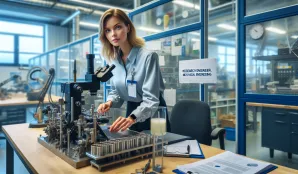
A research engineer in mechanical engineering primarily works on developing, testing, and improving mechanical products and processes. Tasks include practical experimental work in laboratories and advanced analysis using digital tools. Many research engineers participate in projects testing and evaluating new materials, designs, or manufacturing methods. Collaboration with other engineers, researchers, and technicians is common, often within interdisciplinary teams. The environment is characterized by high demands for accuracy, creative problem solving, and continuous technological development, meaning the workday can vary between field studies, lab work, and report writing.
Read more ->