- Salary statistics
- Costume designer salary
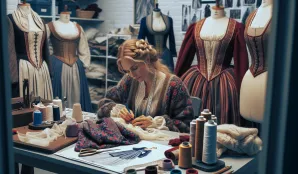
Costume designer salary
Latest available salary statistics are for 2025. Compare average pay, salary range and related job listings.
35 400 - 37 200 SEK / month
Women earn 103% of what men do.
Kultur, media, design
Related tools
Salary progression Costume designer
What does a costume designer do? – Tasks and work environment
The primary task of a costume designer is to develop, design, and be responsible for stage costumes and wardrobe for theater, film, TV, and stage productions. The work involves close collaboration with directors, set designers, and actors to ensure that the costumes align with the production’s vision, time period, and characters. The work environment often includes ateliers, workshops, rehearsals, and filming locations, where the pace can be intense and workdays varied. It is common to work independently and in teams, and many costume designers work as freelancers or on a project basis within the cultural sector.
Salary development over time
The salary development for costume designers has been clearly positive over the past three years. In 2022, the average salary was 34,200 SEK per month, rising to 39 300 SEK in 2023 and further to 36 700 SEK in 2024. This represents an increase of approximately 15% during this period. This increase can partly be explained by a higher demand for skilled workers in cultural production, as well as general salary adjustments in the culture and media sectors. Although the job market is project-based and competitive, technological development and new production formats have helped raise the profession’s status and salary levels. Despite the limited number of permanent positions, the freelance market and the possibility to combine different assignments have created better negotiation opportunities for many professionals.
Costume designer salary – complete overview
- Average salary: 36 700 SEK/month
- Lowest salary: 34,200 SEK/month (2022 level)
- Highest salary: 36 700 SEK/month (2024 level)
- Hourly wage: 236 SEK
- Gender differences: Women earn 37 100 SEK, no data for men
- Regional differences: No reliable data available
Education and qualifications
To work as a costume designer, an artistic education focusing on textiles, fashion, or stage costume is often required, usually from higher education or vocational colleges. Practical experience and a portfolio are highly valued, and many combine formal education with internships in theater, film, or TV production. It is also common to supplement with short courses in sewing, design, and historical costumes to broaden skills.
- Formal education: Degree in textiles, fashion, or costume design (2–4 years)
- Internships: Often necessary during studies or as traineeships
- Courses/certifications: Additional courses in sewing, textile knowledge, pattern making
- Prerequisites: Artistic background or experience in textile craftsmanship
- Self-study/online: Opportunities to deepen knowledge via online courses and workshops
Many costume designers have the opportunity to work on everything from theater and film to advertising and music videos, which provides a varied daily life and unique challenges. The profession requires both creativity and good organizational skills, as quick changes and solutions are often part of the workday.
Common benefits and compensations
Costume designers are often offered benefits such as wellness allowances, access to workshops and work clothing, and opportunities for further training or industry events. In project-based employment, travel allowances and additional pay for unsociable hours may also be provided, especially for tours or filming at different locations. Many freelancers can influence their working conditions through negotiations on fees and working hours.
Competition and challenges
The costume design profession is characterized by tough competition, largely due to the limited number of permanent positions within institutions and major productions. Many costume designers work as freelancers and need to actively build networks and portfolios to secure new assignments. Uncertainty about the duration and scope of projects is a challenge, as well as the demands for continuous updating of knowledge in materials, techniques, and fashion. The creative freedom of the profession attracts many, but high demands are placed on flexibility, problem-solving, and working under time pressure. Despite this, the role of a costume designer is considered very rewarding for those passionate about culture and creation.
Tips for aspiring costume designers
To succeed as a costume designer, it’s good to combine a strong creative drive with practical skills and flexibility. Having an eye for detail and a sense of color and form is crucial, especially when interpreting and realizing the director’s vision. It’s also important to be organized and stress-resistant, as the pace is often high and deadlines tight. Building a broad network through internships and collaborations can open doors to new assignments, and a constant willingness to learn new techniques and materials provides a competitive advantage. Good teamwork and responsiveness to the team’s needs make the work smoother, while clear communication facilitates in stressful situations. Finally, initiative and the ability to find creative solutions are highly valued in the profession.
Key facts about costume designers
- Education level: Degree in textiles, fashion, or costume design
- Work environment: Project-based, often in theater, film, or TV productions
- Typical employment: Freelance or temporary employment
- Demand: High competition, 620 available jobs within the profession
- Special skills: Textile craftsmanship, design, historical costumes
Career paths and future prospects
After three to five years in the profession, a costume designer can advance to managerial roles such as costume supervisor or specialize within film, theater, or TV production. It is also possible to work as a consultant, mentor, or teacher in costume design education. According to the Swedish Public Employment Service’s forecasts, there is no specific future forecast for the profession, but within the group "Stage managers and script supervisors," there are many available jobs and ongoing demand for qualified professionals. Those who combine creativity with project management and networking have good opportunities to develop and broaden their work within the culture and media industries.
Frequently asked questions about costume designers
- What does a costume designer earn?
- A costume designer has an average salary of 36 700 SEK per month. - What education is required to become a costume designer?
- Higher education or vocational training in textiles, fashion, or costume design is recommended. - Do costume designers mostly work as freelancers?
- Yes, most work freelance or within project-based employment. - Are there gender differences in salary?
- Women earn an average of 37 100 SEK, with no data for men. - What are the future prospects for the profession?
- No specific forecast, but the profession has 620 available jobs. - What personal qualities are important for a costume designer?
- Creativity, collaboration skills, flexibility, and stress tolerance are essential qualities. - What is the work environment like for a costume designer?
- The work environment is often project-based, varied, and may involve work at different locations and times.

Salary distributed by age and sector
| Age | Base salary | Monthly salary | |
|---|---|---|---|
| 25-34 | 33900 kr | 34400 kr | |
| 55-64 | 38800 kr | 39900 kr | |
| Snitt | 103% | 36000 kr | 36700 kr |
| Age | Base salary | Monthly salary | |
|---|---|---|---|
| 25-34 | 33900 kr | 34400 kr | |
| 55-64 | 38800 kr | 39900 kr | |
| Snitt | 103% | 36000 kr | 36700 kr |
| Age | Base salary | Monthly salary | |
|---|---|---|---|
| 25-34 | 33900 kr | 34400 kr | |
| 55-64 | 38800 kr | 39900 kr | |
| Snitt | 103% | 36000 kr | 36700 kr |
| Age | Base salary | Monthly salary | |
|---|---|---|---|
| Snitt | 103% | 35700 kr | 36100 kr |
| Age | Base salary | Monthly salary | |
|---|---|---|---|
| Snitt | 103% | 35700 kr | 36100 kr |
| Age | Base salary | Monthly salary | |
|---|---|---|---|
| Snitt | 103% | 35700 kr | 36100 kr |
| Age | Base salary | Monthly salary | |
|---|---|---|---|
| Snitt | 103% | 36200 kr | 37100 kr |
| Age | Base salary | Monthly salary | |
|---|---|---|---|
| Snitt | 103% | 36200 kr | 37100 kr |
| Age | Base salary | Monthly salary | |
|---|---|---|---|
| Snitt | 103% | 36200 kr | 37100 kr |

About the data
All information displayed on this page is based on data from the Swedish Central Bureau of Statistics (SCB), the Swedish Tax Agency and the Swedish employment agency. Learn more about our data and data sources here.
All figures are gross salaries, meaning salaries before tax. The average salary, or mean salary, is calculated by adding up the total salary for all individuals within the profession and dividing it by the number of individuals. For specific job categories, we have also considered various criteria such as experience and education.
Profession Costume designer has the SSYK code 3433, which we use to match against the SCB database to obtain the latest salary statistics.
-

Project Coordinator for Growing Industrial Company in Södertälje
Stage managers and script supervisors etc.
Sun, 26 Jul 2026 - 01:29 -

Production Worker for Global Tech Company in Stockholm
Stage managers and script supervisors etc.
Sun, 26 Jul 2026 - 00:44 -

Production Assistant – Immediate Start in Gothenburg
Stage managers and script supervisors etc.
Fri, 17 Jul 2026 - 06:48 -
Production Assistant in Gothenburg (Full-time/Immediate Start)
Stage managers and script supervisors etc.
Fri, 17 Jul 2026 - 06:32 -

Job as a Packer and Photo Handler – Monday to Friday
Stage managers and script supervisors etc.
Wed, 15 Jul 2026 - 21:22
Compare salary, work tasks and job outlook in adjacent occupations to find roles with similar skills or pay levels.
-

Average salary: 47 400 SEK/month • Kultur, media, design
Musicians, singers and composers
Compare with Costume designer
Sat, 25 Jul 2026 - 22:30 -
Average salary: 42 300 SEK/month • Kultur, media, design
Image and broadcast technicians
Compare with Costume designer
Sat, 25 Jul 2026 - 23:10 -

Average salary: 41 400 SEK/month • Kultur, media, design
Museum curators etc.
Compare with Costume designer
Wed, 22 Jul 2026 - 21:01 -

Average salary: 42 800 SEK/month • Kultur, media, design
Authors etc.
Compare with Costume designer
Sat, 25 Jul 2026 - 21:18 -

Average salary: 51 000 SEK/month • Kultur, media, design
Directors and producers of film, theater etc.
Compare with Costume designer
Sat, 25 Jul 2026 - 01:55 -

Average salary: 42 300 SEK/month • Kultur, media, design
Image and broadcast technicians
Compare with Costume designer
Mon, 20 Jul 2026 - 02:43


