News and articles
- Home
- Articles






Latest posts

A special educator specializing in play therapy primarily works to support children and young people who are in hospitals or institutions, often due to long-term illness or treatment. The tasks include creating a safe and stimulating environment where play, conversations, and educational activities are used to promote the child's development and well-being. The special educator works closely with healthcare staff, teachers, and parents to tailor interventions based on each child's individual needs. The work environment is characterized by presence in hospital settings or dedicated play therapy rooms, which requires flexibility, empathy, and the ability to handle emotional situations.
Read more ->
A special education teacher in a playroom supports children's learning and development through play, with a particular focus on children with disabilities. Tasks revolve around planning, implementing, and evaluating pedagogical interventions where play materials are used as tools to stimulate communication, motor skills, and social abilities. Collaboration with parents, other educators, and sometimes healthcare staff is central, as is guiding and training in adapted play. The work environment is usually located in playroom activities, preschools, or schools and is characterized by variety, creativity, and close contact with children and their networks.
Read more ->-

Opinion Landscape: Novus February 2026 – Social Democrats Still Largest
Thu, 19 Feb 2026 - 01:35 -

Policy rate remains at 1.75% – Riksbank signals stability
Thu, 29 Jan 2026 - 14:02


A special education teacher with a hearing focus works to support children, adolescents, or adults with hearing impairments or deafness. Tasks include pedagogical mapping, adapting the learning environment, mentoring colleagues, and collaborating with guardians and other actors. The work environment often comprises schools, specialized units, or habilitation centers where accessibility, technical aids, and interdisciplinary collaboration are central. The teacher plays a key role in creating inclusive learning environments and contributing to everyone's right to education.
Read more ->
A Specialoptiker works with advanced vision examinations and adaptations of visual aids for individuals with special needs, such as eye diseases or visual impairments. Tasks include in-depth analysis of visual problems, fitting of specialized glasses, contact lenses, and other optical aids, as well as collaboration with ophthalmologists and other healthcare specialists. The work environment is usually clinical, in private or public healthcare, where the Specialoptiker encounters both children and adults with complex needs. A careful, empathetic, and methodical approach is often required as each patient has individual challenges and solutions.
Read more ->
A special education teacher in training school supports and teaches students with extensive intellectual disabilities. Tasks include adapting instruction to each student's individual needs, developing special pedagogical methods, and collaborating with other school staff, parents, and sometimes habilitation services or other support agencies. The environment is often small-scale, with smaller student groups and close cooperation between various professional roles. The focus is on creating safety and structure, and working long-term on students' communication, independence, and social development.
Read more ->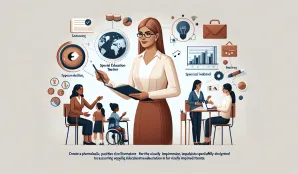
A special education teacher specializing in visual impairments works to support and teach students with reduced vision or blindness. The main tasks include adapting teaching materials, developing individual educational plans, and collaborating with other school staff to ensure students receive the help they need. This often involves working with alternative learning aids such as Braille, tactile images, and digital tools. The work environment is characterized by close contact with students, guardians, and colleagues, as well as a need for flexibility to meet individual needs in various educational settings, both in classrooms and in one-on-one situations.
Read more ->
Special educators focusing on hearing support and teach students with hearing impairments or deafness. Tasks include adapting teaching, developing individual pedagogical strategies, and collaborating with other school staff and parents. The work often takes place in primary and secondary schools, sometimes also in special schools or resource centers. The environment is characterized by close student contact, interdisciplinary collaboration, and high pedagogical flexibility. The special educator is also responsible for evaluating students' development and contributing to accessible learning for all.
Read more ->
A special educator in upper secondary special school works to support and develop learning for students with various types of disabilities. Tasks include adapting teaching to individual needs, conducting pedagogical assessments, collaborating with other teachers, student health teams, and sometimes parents. The environment is often flexible and inclusive, with work taking place both in classrooms and in smaller groups or individually. The special educator's role is crucial in enabling each student to reach their full potential based on their conditions.
Read more ->
A special education teacher in primary school works to support students who need additional help with learning. Tasks include designing, implementing, and following up on individual education plans in consultation with colleagues, guardians, and student health services. Much of the role involves working both one-on-one with students and collaboratively in the classroom, as well as guiding and supporting other teachers on adapted teaching. The work environment is characterized by close collaboration with other educators and often a flexible approach, as student needs vary over time and between schools.
Read more ->
Special education teachers in the compulsory special school support students with intellectual disabilities or other special needs within the school environment. Their tasks include adapting teaching to each student's individual conditions, designing pedagogical plans, and working closely with other teachers, student health services, and guardians. The role also involves following up and documenting students' development, as well as creating a safe and inclusive learning environment. The special educator often provides guidance to colleagues and contributes to the school's overall work with extra adaptations and special support.
Read more ->