- Articles
- General

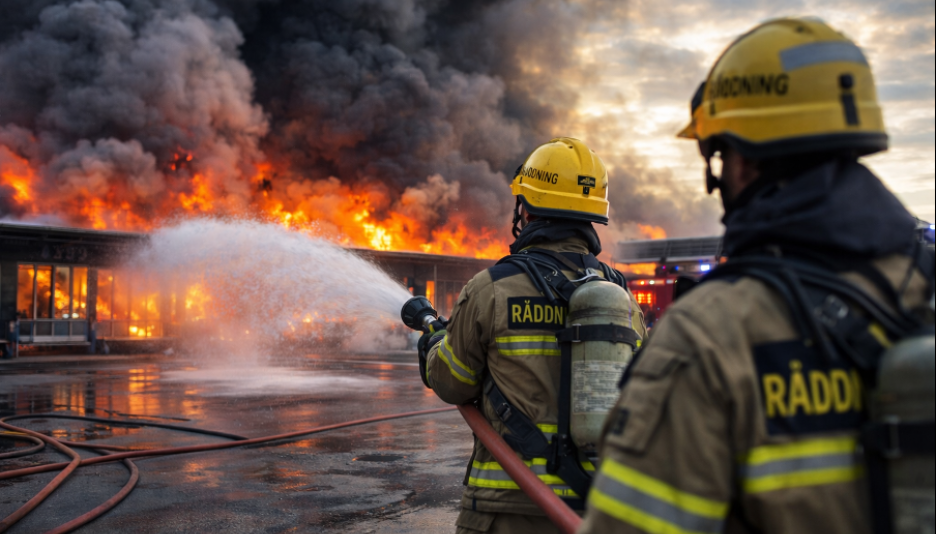

Explosion Protection from a Socioeconomic Risk Management Perspective
Swedish industry contributes both to employment and to public financing through taxes and fees. At the same time, industrial activities are often associated with risks that, when realized, have consequences far beyond the individual facility. From a socioeconomic perspective, the industry's safety efforts are therefore a matter of managing risks at a systems level and of how costs are distributed between private and public actors.
Explosion and fire risks are common within the industry
Explosion and fire risks occur in many parts of Swedish industry, especially in operations where flammable gases, liquids, or dust are handled during regular production.
Statistics from emergency services show recurring cases of fires and fire incidents within manufacturing, process industries, and warehousing. In sectors such as metal and machinery manufacturing, wood products, and pulp and paper industries, such events happen regularly, often linked to machinery, hot work, or handling of combustible materials.
Incidents also occur in the food and chemical industries, stemming from hazardous environments with dust or vapors. The scope of these events varies from minor incidents to fully developed fires, but all require intervention from municipal emergency services.
The ATEX Directive as a foundation for structural risk management
The ATEX framework, including ATEX classification, is a common European system used to manage risks associated with explosive atmospheres in industrial environments. It is divided into two main parts with different functions.
One part concerns product requirements, establishing basic safety requirements for equipment and protective systems used in potentially explosive environments. The other part pertains to workplace requirements, focusing on how workplaces should be designed and managed to reduce the risk of explosive atmospheres forming or causing accidents.
The purpose of this division is to create an EU-harmonized regulation with a cohesive approach regarding both technology and the working environment. Common definitions, zone classifications, and fundamental risk management principles provide the necessary conditions for equivalent safety regardless of where the operation is conducted.
The regulation is based on a preventive logic at the system level, meaning that identification, assessment, and management of risks should occur before an accident happens, rather than as a reaction to events that have already occurred.
Preventive work for efficient use of societal resources
From a socioeconomic perspective, preventive explosion protection can be viewed as a form of risk-reducing investment. Managing risks before they materialize reduces the likelihood of disruptions that could otherwise lead to significant economic consequences. The foundation is a balance between risk and cost, utilizing available resources to limit potentially extensive negative outcomes rather than dealing with consequences afterward.
A functioning Swedish economy requires stable industrial production. Various types of domestic activities must be able to operate without recurring interruptions to ensure delivery capacity, employment, and tax revenues. At the same time, human capital is protected by preventing unnecessary exposure of workers to serious risks that could lead to long-term absence or exclusion from the labor market.
Effective preventive work also reduces the burden on public systems. When fewer serious accidents occur, pressure on healthcare, emergency services, and social insurance decreases. This, in turn, frees up resources for other societal needs.
Responsibility, supervision, and cost distribution
The responsibility for managing explosion risks within industry primarily lies with the employer, who is expected to operate in a manner that limits risks to life, health, and property. This responsibility covers both employees and the surrounding environment. The principle of due diligence means that risks should not only be managed when they become apparent but also when they can reasonably be anticipated based on the nature of the activity.
Society contributes through public supervision aimed at ensuring that operations meet applicable requirements and do not pose unreasonable risks to the surroundings. If compliance is lacking, consequences can be economically significant even outside the company, such as increased costs for public interventions or legal proceedings.
In the event of accidents, a similar responsibility distribution applies. Although the company bears direct responsibility, some consequences fall on collective systems. This makes the entire area a matter of how risk and costs are allocated between private actors and society at large.
How preventive explosion protection is organized in practice
Preventive explosion protection within industry must be organized systematically, with risks identified, analyzed, and documented thoroughly.
The work usually begins with a risk assessment of the current operation, including mapping how flammable substances, processes, and potential ignition sources are handled. Based on this assessment, the facility is divided into zones indicating the likelihood of explosive atmospheres occurring during normal operation or under abnormal conditions.
Zone classification forms the basis for subsequent work, guiding the selection of equipment, technical protective measures, and organizational routines. All of this is compiled into an explosion protection document that describes the risks, zone divisions, and the measures and instructions applicable to each area. The documentation must be kept up to date and accessible to relevant personnel. The preventive work is integrated into the systematic work environment management, meaning explosion risks are handled as part of ongoing follow-up, change management, and internal control of the work environment.
System effects of inadequate risk management
If the industry's risk management fails, it can lead to consequences that extend far beyond the facility itself. Major accidents, for example, can affect employment at a regional level by halting production for an extended period or forcing operations to downsize or cease altogether.
Supply chains can also be impacted. Companies dependent on inputs or services from a affected operation may have to adapt themselves. At the national level, such disruptions can influence competitiveness and supply capacity within key industrial sectors.











Sweden's national debt
-

Up to 25% off experiences for mom – Celebrate Mother’s Day with Live it
Tue, 26 May 2026 - 12:00


