- Salary statistics
- Nuclear maker, craft salary
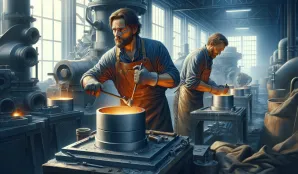
Nuclear maker, craft salary
Latest available salary statistics are for 2025. Compare average pay, salary range and related job listings.
31 500 - 32 100 SEK / month
Industriell tillverkning
Related tools
Salary progression Nuclear maker, craft
What does a core maker in craftsmanship do? – Tasks and work environment
A core maker in craftsmanship primarily works with manufacturing cores used in metal casting. These cores shape the internal cavities in cast products and are made from sand, binders, and sometimes other additives. Tasks include mixing materials, forming and curing cores, checking dimensional accuracy, and performing quality control on finished products. The work environment is often industrial, involving a workshop setting with noise, dust, and high temperatures, where protective equipment is a natural part of daily life. Collaboration with foundry workers and other craftsmen is common, and the tasks require both precision and accuracy.
Salary development over time
The salary for a core maker in craftsmanship has shown a stable and cautious increase in recent years. In 2022, the average salary was 30,700 SEK per month, which slightly decreased to 31 600 SEK in 2023, then increased to 32 100 SEK in 2024. The total change over this period is approximately 2.9%, indicating a recovery and some positive salary development after a minor dip. Causes of these variations may include changes in demand for foundry work, the availability of skilled labor, and overall industry salary trends. Since the profession belongs to a narrower craft group, wages are also influenced by the size of the regional industry and technological development.
Core maker in craftsmanship salary – comprehensive overview
- Average salary: 32 100 SEK/month
- Lowest/Highest salary: Varies depending on experience and region
- Hourly wage: 190 SEK/hour (based on 166 hours/month)
- Gender differences: Men 32 400 SEK, specific data on women is unavailable
- Regional differences: Salaries can be affected by industry size and demand in different parts of the country
Education and qualifications
To work as a core maker in craftsmanship, a vocational upper secondary education in industrial technology or similar field is generally required, with specialization in foundry work. Practical experience and apprenticeships are often crucial for developing professional skills. Some employers offer internal courses and further training, and in the industry, accuracy and understanding of technical drawings are highly valued.
- Vocational upper secondary education: Industrial technology program, specialization in foundry (approx. 3 years)
- Practical training/apprenticeship: Common for developing practical skills
- Internal courses: Often offered in materials technology and safety
- Prerequisites: Precision, technical understanding, and good physics
- Tips for choosing: Interest in craftsmanship and industrial work facilitates educational choices
Core makers often have the opportunity to specialize in advanced forms and materials, which can lead to tasks in prototype development and unique industrial projects. This specialization can provide variety and in-depth knowledge, which is in demand in more technologically advanced foundries.
Common benefits and compensations
Common benefits for core makers in craftsmanship include often shortened working hours, wellness allowances, opportunities for training and development, as well as access to work clothing and protective gear. Some workplaces also offer bonuses based on production targets, insurance, and additional pension contributions.
Competition and challenges
The job market for core makers in craftsmanship is relatively limited and specialized, which can mean some competition for the most attractive positions. The profession requires both technical knowledge and practical experience, and there is a need to constantly stay updated on new materials and casting techniques. Digitalization and automation in the industry may change work tasks and require further training. At the same time, attracting younger people to the profession is a challenge, as it is often perceived as physically demanding and traditional. Nevertheless, there are good opportunities for driven individuals who want to develop within the craft.
Tips for those who want to become a core maker in craftsmanship
To succeed as a core maker in craftsmanship, it is important to be precise and detail-oriented, as work requires accuracy at every stage. Being solution-oriented helps when unexpected problems arise in the production process and contributes to efficient work. Good physical endurance is also valuable, as the profession often involves heavy lifting and working in challenging environments. Showing interest in technology and material knowledge can open doors to more advanced tasks and specialization. Taking advantage of internship and on-the-job learning opportunities is highly recommended, as practical experience is invaluable. Being cooperative and communicating clearly with colleagues facilitates daily work. Finally, curiosity and willingness to develop skills are advantageous, as the industry is constantly evolving.
Key facts about core makers in craftsmanship
- Educational level: Vocational upper secondary education, often with practical training
- Work environment: Industrial workshop environment with safety equipment requirements
- Typical working hours: Full-time, often daytime but shift work also occurs
- Demand: 1,437 job openings within the foundry group
- Special skills: Material science, reading technical drawings, and mold making
Career paths and future prospects
After three to five years as a core maker in craftsmanship, opportunities may exist to advance to supervisor, production planner, or specialist in casting technology. Further education can also open doors to roles in quality control or technical development. According to the Swedish Public Employment Service's forecasts, there is currently no specific assessment for the profession due to limited data, but with 1,437 job openings in the foundry group, demand is expected to continue. Industry development towards more advanced and automated production may also create new career paths for those willing to further their education or specialize in the field.
Frequently asked questions about core makers in craftsmanship
- What does a core maker in craftsmanship earn?
- The average salary is 32 100 SEK per month, with variation depending on experience and region. - What education is required to become a core maker?
- A vocational upper secondary education in industrial technology, often with practical training in foundry work, is recommended. - Are there many job opportunities for core makers?
- Within the foundry group, there are 1,437 job openings, indicating good demand. - What is the work environment like for core makers?
- Work is performed in an industrial environment with noise, dust, and high temperatures, where protective equipment is used. - What personal qualities are important?
- Attention to detail, technical interest, physical endurance, and teamwork skills are highly valued. - Are there salary differences between men and women?
- Men have an average salary of 32 400 SEK, but specific data on women is unavailable. - What career opportunities are available within the profession?
- Opportunities for advancement to supervisor, specialist, or further education in technical development.

Salary distributed by age and sector
| Age | Base salary | Monthly salary | |
|---|---|---|---|
| Snitt | 31500 kr | 32100 kr |
| Age | Base salary | Monthly salary | |
|---|---|---|---|
| Snitt | 31500 kr | 32100 kr |
| Age | Base salary | Monthly salary | |
|---|---|---|---|
| Snitt | 31500 kr | 32100 kr |
| Age | Base salary | Monthly salary | |
|---|---|---|---|
| Snitt | 31700 kr | 32400 kr |
| Age | Base salary | Monthly salary | |
|---|---|---|---|
| Snitt | 31700 kr | 32400 kr |
| Age | Base salary | Monthly salary | |
|---|---|---|---|
| Snitt | 31700 kr | 32400 kr |

About the data
All information displayed on this page is based on data from the Swedish Central Bureau of Statistics (SCB), the Swedish Tax Agency and the Swedish employment agency. Learn more about our data and data sources here.
All figures are gross salaries, meaning salaries before tax. The average salary, or mean salary, is calculated by adding up the total salary for all individuals within the profession and dividing it by the number of individuals. For specific job categories, we have also considered various criteria such as experience and education.
Profession Nuclear maker, craft has the SSYK code 7211, which we use to match against the SCB database to obtain the latest salary statistics.
-

Concrete Worker for Thomas Betong in Magra – Consultancy Role with Employment Opportunity
Casters
Thu, 11 Jun 2026 - 09:17



Compare salary, work tasks and job outlook in adjacent occupations to find roles with similar skills or pay levels.
-
Average salary: 33 700 SEK/month • Industriell tillverkning
Other machine operators, food industry etc.
Compare with Nuclear maker, craft
Tue, 14 Jul 2026 - 11:56 -

Average salary: 37 800 SEK/month • Industriell tillverkning
Machine operators, cement, stone and concrete products
Compare with Nuclear maker, craft
Mon, 13 Jul 2026 - 10:26 -

Average salary: 42 500 SEK/month • Industriell tillverkning
Process operators, paper
Compare with Nuclear maker, craft
Tue, 14 Jul 2026 - 08:16 -
Wallpaper roller engravers salary
Average salary: 35 300 SEK/month • Industriell tillverkning
Prepress technicians
Compare with Nuclear maker, craft
Tue, 14 Jul 2026 - 11:05 -

Average salary: 36 900 SEK/month • Industriell tillverkning
Other process and machine operators
Compare with Nuclear maker, craft
Tue, 14 Jul 2026 - 13:04 -

Hasplare, textile industry salary
Average salary: 32 200 SEK/month • Industriell tillverkning
Other machine operators, textile, leather and leather industry
Compare with Nuclear maker, craft
Tue, 14 Jul 2026 - 11:54


