- Salary statistics
- Scuba divers salary
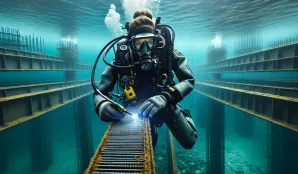
Scuba divers salary
Latest available salary statistics are for 2025. Compare average pay, salary range and related job listings.
40 543 - 41 068 SEK / month
Bygg & anläggning
Related tools
Salary progression Scuba divers
What does a construction diver do? – Tasks and work environment
Construction divers primarily work on performing construction and maintenance tasks underwater. Their duties range from inspecting and repairing bridge foundations, quays, and harbor facilities to welding, concrete work, and clearing operations on the seabed. The work environment is characterized by physically demanding and often risky conditions, where safety and meticulous routines are crucial. The work is usually performed in teams and may involve travel to various sites across the country, sometimes abroad.
Salary development over time
The salary for construction divers has shown a steady but slow increase over the past three years, reflecting both the specialized skills required and a relatively limited competition within the profession. In 2022, the average salary was 38,434 SEK per month, increasing to 38 909 SEK in 2023 and further to 41 068 SEK in 2024. The total increase amounts to approximately 1.2% over three years, which is slightly below the average for the construction and civil engineering sector. The slow but steady salary development can be explained by the niche nature of the profession, with relatively few practitioners and stable demand, while technological advances and safety requirements demand ongoing training. Despite the modest increase, the salary remains competitive compared to many other professions in construction and civil engineering.
Construction diver salary – full overview
- Average salary: 41 068 SEK/month
- Lowest/Highest salary: Salary range varies depending on experience and employer, but the average is 41 068 SEK/month
- Hourly wage: 234 SEK/hour (based on 166 working hours/month)
- Gender differences: Specific data for men and women are not available
- Regional differences: No detailed statistics available at present
Education and qualifications
To work as a construction diver, a combination of formal diving training and specialized vocational education in construction work is required. The industry demands high physical fitness and technical competence, and education is often combined with internships under supervision. Further training and certifications are often necessary to stay updated with safety standards and new technology.
- Formal education: Vocational training for construction divers (about 1.5 years)
- Certifications: Diving certificates according to the Work Environment Authority's requirements (commercial diving)
- Practical training: Longer internships during education are standard
- Prerequisites: Approved medical examination and swimming skills
- Tips for choosing: Select providers with good industry contacts and opportunities for internships with established companies
Construction divers often work in shifts and under varying weather conditions, requiring great adaptability and endurance. Many projects are carried out in environments where good teamwork and underwater communication are crucial for safety and work quality.
Common benefits and compensations
In addition to the base salary, benefits such as extra diving allowances, per diems for work in other locations, and access to personal equipment and protective clothing are often offered. Many employers also provide wellness grants and insurance covering accidents and illnesses, which are especially important in a high-risk profession like this.
Competition and challenges
Competition for jobs as a construction diver is moderate, but entering the profession is demanding and requires good physical health and specialized training. One of the biggest challenges is the physically and mentally demanding working conditions, where work is performed in cold water, with limited visibility, and sometimes under time pressure. Safety standards are very high, and continuous training is necessary to keep up with technological developments and legal requirements. Additionally, the availability of assignments may vary depending on economic conditions and seasons, requiring flexibility and readiness to work in different locations.
Tips for those who want to become a construction diver
To succeed as a construction diver, it is good to be goal-oriented, stress-resistant, and flexible in both thinking and action. Early investment in a solid education and actively seeking internships provides valuable experience and contacts in the industry. Good physical condition and endurance are crucial, as the job often involves long days and working in tough environments. Being thorough and following safety routines is a given, while teamwork and communication skills are important for functioning in underwater teams. Continuously furthering your education and staying updated on new technology and regulations increases your chances of getting the most attractive assignments. Finally, being solution-oriented and having a strong interest in technology and problem-solving is often desired for complex work tasks.
Key facts about construction divers
- Educational level: Vocational training with commercial diving certification
- Work environment: Underwater, often in tough and varying conditions
- Work form: Project-based, often shifts and travel
- Demand: Approximately 379 available jobs according to latest statistics
- Special skills: Safety procedures, welding, concrete and construction work underwater
Career paths and future prospects
After three to five years in the profession, many construction divers have the opportunity to advance to roles such as dive leader, supervisor, or specialist in underwater welding and inspection. Some choose to further educate themselves as instructors or start their own consulting businesses for national and international assignments. According to the latest forecast from the Employment Service, the future outlook is stable, with continued demand for qualified divers for infrastructure projects and maintenance of bridges, harbors, and other facilities. Technological development and increasing requirements for maintaining existing infrastructure are also expected to contribute to ongoing demand for the profession.
Frequently asked questions about construction divers
- What does a construction diver earn?
- The average salary is 41 068 SEK per month, with an hourly wage of 234 SEK. - What education is required to become a construction diver?
- Vocational training with commercial diving certification and practical experience are required. - What is the work environment like for a construction diver?
- The work takes place underwater, often in tough environments with high safety standards. - Are there many jobs for construction divers?
- There are approximately 379 available jobs according to current statistics. - What personal qualities are important for the profession?
- Good physical condition, stress resilience, teamwork skills, and thoroughness are essential. - What does diving allowance mean?
- Diving allowance is an extra compensation paid for work underwater, in addition to the base salary. - What are the future prospects for construction divers?
- The outlook is considered stable with continued demand for qualified divers.

Salary distributed by age and sector

About the data
All information displayed on this page is based on data from the Swedish Central Bureau of Statistics (SCB), the Swedish Tax Agency and the Swedish employment agency. Learn more about our data and data sources here.
All figures are gross salaries, meaning salaries before tax. The average salary, or mean salary, is calculated by adding up the total salary for all individuals within the profession and dividing it by the number of individuals. For specific job categories, we have also considered various criteria such as experience and education.
Profession Scuba divers has the SSYK code 7115, which we use to match against the SCB database to obtain the latest salary statistics.
Compare salary, work tasks and job outlook in adjacent occupations to find roles with similar skills or pay levels.
-

Average salary: 46 800 SEK/month • Bygg & anläggning
Well drillers etc.
Compare with Scuba divers
Tue, 14 Jul 2026 - 07:15 -

Control technician, construction salary
Average salary: 50 800 SEK/month • Bygg & anläggning
Engineers and technicians in construction and engineering
Compare with Scuba divers
Tue, 14 Jul 2026 - 07:14 -

Calculation engineer (construction), civil engineer salary
Average salary: 54 900 SEK/month • Bygg & anläggning
Civil engineering professions in construction and engineering
Compare with Scuba divers
Mon, 13 Jul 2026 - 03:18 -

Average salary: 42 300 SEK/month • Bygg & anläggning
Bricklayers etc.
Compare with Scuba divers
Mon, 13 Jul 2026 - 20:21 -

Average salary: 45 800 SEK/month • Bygg & anläggning
Miners and quarry workers
Compare with Scuba divers
Mon, 13 Jul 2026 - 18:39 -

Average salary: 50 800 SEK/month • Bygg & anläggning
Engineers and technicians in construction and engineering
Compare with Scuba divers
Sun, 12 Jul 2026 - 03:22


