News and articles
- Home
- Articles






Latest posts
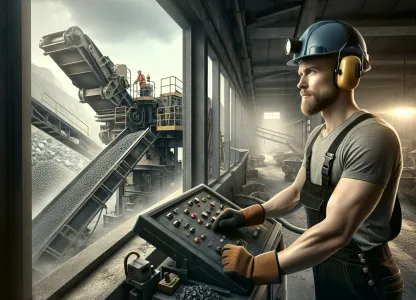
Crushing plant operators play a central role in the mining and construction industries, responsible for monitoring and controlling machines that crush stone, ore, or other materials. Tasks include starting, stopping, and adjusting the settings of crushers, overseeing production, and ensuring that equipment functions safely and efficiently. They also perform basic maintenance and troubleshooting of machines. The work environment is often noisy and dusty, requiring protective gear and attention to safety procedures. Work is typically outdoors or in large industrial halls, with shifts during day and night depending on the facility's operation.
Read more ->
A Krosskötare in ore crushing is responsible for monitoring and controlling machines that crush and grind ore into different fractions for further processing within the mining and mineral industry. The work is usually carried out in larger industrial environments where safety, precision, and technical knowledge are crucial. Daily tasks include starting and stopping crushing plants, monitoring production flow, troubleshooting operational issues, and performing basic maintenance and servicing of the machines. The work environment can be noisy and dusty, often requiring the use of protective gear. Shift work is common, and tasks are performed both indoors and outdoors depending on the facility's layout.
Read more ->-

Opinion Landscape: Novus February 2026 – Social Democrats Still Largest
Thu, 19 Feb 2026 - 01:35 -

Policy rate remains at 1.75% – Riksbank signals stability
Thu, 29 Jan 2026 - 14:02


A Kronokommissarie is a specialized position within the Swedish Enforcement Authority (Kronofogdemyndigheten) focusing on leading and coordinating cases involving debt collection, enforcement of judgments, and seizures. The tasks include making decisions about enforcement, guiding colleagues, participating in larger investigations, and ensuring that laws and regulations are followed in all actions. The work is mainly office-based but can also involve field visits, such as seizures or inventories. The role requires high integrity, good analytical skills, and the ability to handle complex cases under time pressure, often in contact with both private individuals and companies.
Read more ->
Kronoinspektörer work with investigating, monitoring, and collecting debts for the state, municipality, or private entities. Tasks include handling claims, contacting debtors and creditors, and making decisions regarding collection measures. The job requires meticulous documentation, gathering financial information, and often collaborating with other authorities. The work is primarily office-based, but meetings with clients and external parties occur regularly. The environment is fast-paced with high demands for discretion, as sensitive cases are handled daily.
Read more ->
A Kronofogde works to ensure that unpaid debts and judgments are enforced according to Swedish law. The profession involves investigating and making decisions about debt collection, conducting seizures, and handling cases related to payment orders. The work requires continuous contact with both individuals and companies, which demands high standards of legal certainty, integrity, and good communication skills. The work environment is primarily office-based, but fieldwork occurs during seizures. The role often involves a fast pace and managing complex situations where legal and human aspects must be balanced.
Read more ->
A Kronoassistent primarily assists the Swedish Enforcement Authority in cases related to debt collection and enforcement of payment orders. Tasks include handling debt collection cases, administering payment plans, contacting debtors, preparing documents and registers, and managing simpler legal cases. The work is often performed in teams with other specialists and requires a high degree of accuracy and integrity. The work environment is generally office-based with a fast pace, where service orientation and structure are key qualities.
Read more ->
A columnist primarily writes personal and reflective texts, often focusing on current social issues, culture, or everyday life. Tasks include research, analysis of current events, and expressing personal thoughts in an engaging and accessible manner. Columnists are usually active in newspapers, magazines, digital media, or radio and TV, where they contribute unique perspectives and voices to public discourse. The work environment is often flexible, with many working from home or remotely, but there are also fixed newsroom environments with high tempo and tight deadlines.
Read more ->
A chrome worker primarily works with surface treatment of metals through chrome plating, where a thin layer of chrome is applied to various components to improve durability, corrosion protection, and appearance. The tasks usually include preparing materials, monitoring the chrome plating process, quality control, and sometimes maintenance of machines and equipment. The work often takes place in industrial environments with special safety procedures and chemical handling, where precision and understanding of technical processes are important qualities.
Read more ->
A life model primarily works by posing for artists and art students during so-called life drawing sessions, where quick sketches of the human body form the basis for practice and artistic development. Tasks involve adopting various poses, often without clothing, for short or longer periods. The environment is usually quiet and focused, often in studios, schools, or art halls. The model needs to demonstrate great body awareness, patience, and the ability to maintain static positions over varying time intervals, sometimes with minimal rest between poses. The profession is characterized by respect and professionalism, where integrity and safety are central aspects.
Read more ->
A bar inspector works with supervision of restaurants, bars, and other establishments serving alcohol. The role includes checking that the businesses comply with alcohol legislation, including licensing, age controls, opening hours, and order. The tasks involve both planned and unannounced visits, reviewing documentation, and conversations with staff and guests. The work is often carried out in the evenings and nights, which means a varied and sometimes demanding work environment where communication skills and integrity are important qualities.
Read more ->