- Salary statistics
- Porcelain maker salary
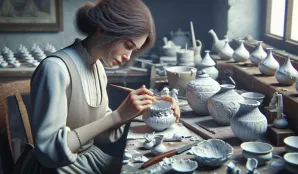
Porcelain maker salary
Latest available salary statistics are for 2025. Compare average pay, salary range and related job listings.
33 800 - 34 000 SEK / month
Hantverksyrken
Related tools
Salary progression Porcelain maker
What does a porcelain restorer do? – Tasks and work environment
Porcelain restorers work with repairing, restoring, and manufacturing porcelain objects with high precision and craftsmanship. Tasks often include grinding, gluing, and painting porcelain details to restore damaged or worn items, often with artistic elements. The environment is usually workshop-based with good lighting and demands for careful, seated work where attention to detail is crucial for the outcome.
Salary development over time
Over the past three years, the salary of a porcelain restorer has shown a downward trend. In 2022, the average salary was 34,382 kronor per month, which slightly decreased to 30 900 kronor in 2023 before falling to 34 000 kronor in 2024. This change corresponds to a total decrease of about 10 percent from 2023 to 2024. Salary development may reflect changes in demand for craft services within porcelain restoration as well as economic conditions in the industry. One possible reason is increased competition among practitioners for a limited number of specialized assignments, affecting salary levels. Variations may also be due to regional differences and shifts in the labor market for craftspeople.
The porcelain restoration profession requires great patience and a sense of detail, making it a particularly suitable craft for individuals with artistic talent and meticulousness.
Porcelain restorer salary – comprehensive overview
- Average salary: 34 000 kr/month
- Lowest/highest salary: Not specified
- Hourly wage: 186 kr/hour (based on 166 hours/month)
- Gender differences: No available data
- Regional differences: No detailed data available
Education and qualifications
The path to becoming a porcelain restorer often involves a combination of craft training in arts and crafts or ceramic technology, along with practical experience. The profession requires careful learning of techniques for material handling and restoration.
- Formal qualifications: Vocational training in arts and crafts or craftsmanship, usually 2–3 years
- Certifications/courses: Specialized courses in porcelain restoration may be available
- Internship/traineeship: Practical experience through apprenticeships or internships is common
- Prerequisites: Basic knowledge of material science and artistic craftsmanship
- Self-study/online: Supplementary education can be obtained via online craft courses
- Tips for choosing: Select training focusing on detailed work and material knowledge
Common benefits and compensations
Porcelain restorers are often offered standard benefits such as collective pension and insurance solutions, as well as wellness allowances. Compensation for overtime and unsociable hours may be provided depending on the employer. Flexible working hours are less common due to the nature of workshop work.
Competition and challenges
The profession of porcelain restorer is relatively niche with limited training places and specialized employers. Competition can therefore be tough if demand for craft services decreases. Another challenge is that the profession requires both artistic finesse and technical precision, placing high demands on the practitioner's skills and patience. The industry is also affected by changes in consumer interest in restoration versus new production.
Tips for those wanting to become a porcelain restorer
To succeed as a porcelain restorer, develop a good sense of detail and patience, since the work is often time-consuming and requires precision. A careful and methodical working style facilitates handling delicate materials and contributes to high-quality results. Creativity and an artistic mindset help in restoration and decorative tasks, which are often part of the profession. It is also important to be resilient and able to handle monotonous moments without losing focus. Good communication skills further strengthen the professional role by enabling effective collaboration with clients and colleagues.
Key facts about porcelain restorers
- Education level: Vocational training in arts and crafts or craftsmanship (2–3 years)
- Salary range: Approximately 34 000 kr/month on average
- Work environment: Workshop-based with a focus on detailed work
- Hourly wage: About 186 kr/hour
- Demand: 341 available jobs within the group of musical instrument makers and other craftspeople
Career paths and future prospects
After gaining some years of experience, porcelain restorers can advance to specialist roles within restoration or work with design and manufacturing of exclusive porcelain products. Some choose to start their own craft business or broaden their skills to other craft professions. The employment agency's forecasts indicate that demand for craft occupations within musical instrument making and arts and crafts is stable with a moderate number of available jobs, providing relatively good opportunities for practitioners with the right skills.
Frequently asked questions about porcelain restorers
- What does a porcelain restorer earn?
- The average salary is approximately 34 000 kronor per month with an hourly wage of about 186 kronor. - What education is required to become a porcelain restorer?
- A vocational education in crafts or ceramic techniques, often 2–3 years, is most common. - Are there regional differences in salary?
- There is no available detailed data on regional salary differences for porcelain restorers. - What is the work environment like for a porcelain restorer?
- The work typically takes place in a workshop environment focusing on detailed work and good lighting. - What personal qualities are important in this profession?
- Precision, patience, and an artistic sense are important qualities for a porcelain restorer. - Is it difficult to find a job as a porcelain restorer?
- Competition can be tough but there are about 341 available jobs within the craftsperson group related to this field. - Can I further my education within the profession?
- Yes, specialized courses and certifications in restoration and decorative work are available.

Salary distributed by age and sector
| Age | Base salary | Monthly salary | |
|---|---|---|---|
| Snitt | 33800 kr | 34000 kr |
| Age | Base salary | Monthly salary | |
|---|---|---|---|
| Snitt | 33800 kr | 34000 kr |
| Age | Base salary | Monthly salary | |
|---|---|---|---|
| Snitt | 33800 kr | 34000 kr |

About the data
All information displayed on this page is based on data from the Swedish Central Bureau of Statistics (SCB), the Swedish Tax Agency and the Swedish employment agency. Learn more about our data and data sources here.
All figures are gross salaries, meaning salaries before tax. The average salary, or mean salary, is calculated by adding up the total salary for all individuals within the profession and dividing it by the number of individuals. For specific job categories, we have also considered various criteria such as experience and education.
Profession Porcelain maker has the SSYK code 7319, which we use to match against the SCB database to obtain the latest salary statistics.
-

Production Staff Wanted at Svebab – Svenska Brandslangsfabriken AB
Musical instrument makers and other artisans
Fri, 10 Jul 2026 - 21:23 -

Engraver and Customer Receptionist at Vasaboden – Full-Time Temporary Position
Musical instrument makers and other artisans
Tue, 7 Jul 2026 - 09:01 -

Screen Printer for Sign Production in Tumba
Musical instrument makers and other artisans
Mon, 29 Jun 2026 - 23:45 -

Machine Operator for Glass Manufacturing in Limmared
Musical instrument makers and other artisans
Thu, 25 Jun 2026 - 22:17 -

Teacher in Wood and Metal Craft at Vasaskolan in Hedemora
Musical instrument makers and other artisans
Thu, 25 Jun 2026 - 21:44
Compare salary, work tasks and job outlook in adjacent occupations to find roles with similar skills or pay levels.
-

Average salary: 33 100 SEK/month • Hantverksyrken
Tailors and atelier seamstresses etc.
Compare with Porcelain maker
Tue, 14 Jul 2026 - 08:16 -

Average salary: 33 100 SEK/month • Hantverksyrken
Tailors and atelier seamstresses etc.
Compare with Porcelain maker
Tue, 14 Jul 2026 - 11:56 -

Average salary: 34 000 SEK/month • Hantverksyrken
Musical instrument makers and other artisans
Compare with Porcelain maker
Tue, 14 Jul 2026 - 07:13 -

Curtain seamstress, studio salary
Average salary: 33 100 SEK/month • Hantverksyrken
Tailors and atelier seamstresses etc.
Compare with Porcelain maker
Tue, 14 Jul 2026 - 11:57 -

Ice cream grinder, other salary
Average salary: 34 000 SEK/month • Hantverksyrken
Musical instrument makers and other artisans
Compare with Porcelain maker
Tue, 14 Jul 2026 - 10:07 -

Average salary: 34 200 SEK/month • Hantverksyrken
Fine, interior and furniture carpenters
Compare with Porcelain maker
Tue, 14 Jul 2026 - 00:44


