- Salary statistics
- Conference technician salary
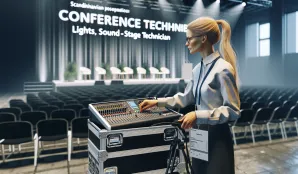
Conference technician salary
Latest available salary statistics are for 2025. Compare average pay, salary range and related job listings.
37 700 - 43 000 SEK / month
Women earn 94% of what men do.
Kultur, media, design
Related tools
Salary progression Conference technician
What does a conference technician do? – Tasks and work environment
A conference technician works with installing, commissioning, and maintaining technical equipment at conferences, meetings, and events. Tasks include handling sound systems, visual and video technology, lighting, and often digital presentation solutions. The profession involves daily contact with both clients and organizers, and work is commonly performed on-site in conference rooms, hotels, trade shows, or similar environments. Flexibility and problem-solving skills are essential, as assignments often vary in scope and technical complexity. The work environment can be physically demanding, especially during transportation and setup of equipment, and sometimes work outside regular office hours.
Salary development over time
The role of conference technician has experienced a clear positive salary trend in recent years. In 2022, the average salary was 35,100 SEK per month, increasing to 38 600 SEK in 2023. In 2024, the average salary has risen further to 39 700 SEK per month, corresponding to an increase of about 10% over two years. This development reflects an increased demand for technical skills as the meeting and event industry invests more in advanced technology and digital solutions. Salary increases can also be linked to skill requirements and rapid technological development, where employers value experience and certified knowledge more highly. There are regional differences, but overall, the profession has strengthened in terms of salary nationwide.
Conference technician salary – comprehensive overview
- Average salary: 39 700 SEK/month
- Lowest salary: 33,600 SEK/month (female), 36,100 SEK/month (male)
- Highest salary: 40,300 SEK/month (female), 43,700 SEK/month (male)
- Hourly wage: 232 SEK/hour
- Gender differences: Women earn 37 800 SEK/month, men 40 000 SEK/month (women 94% of men's salary)
- Regional differences: No specific salary data available, but variation may occur depending on labor market and demand.
Education and qualifications
To work as a conference technician, a high school education in electrical engineering, technology, or media is usually required, complemented by courses and practical experience in sound, lighting, and visual technology. Many employers also require certifications or specialized courses in areas such as AV technology or networking. Internships or trainee positions are common entry points into the profession, and self-study is an important supplement to formal education.
- High school education: Technology, electrical, or media programs (3 years)
- Post-secondary courses: AV technology, sound and lighting production
- Certifications: Examples include AVIXA or similar in AV technology
- Internships/trainee: Common at technology companies and event agencies
- Prerequisites: Interest in technology, problem-solving skills, and social competence
- Self-study/online: Courses via YouTube, educational portals, or industry organizations
Many conference technicians quickly gain a unique insight into a broad spectrum of activities – from international companies to cultural events and societal debates. The curious and flexible individual often has the opportunity to work at places and on projects that few other professions reach.
Common benefits and compensations
For conference technicians, it is common to be offered benefits such as overtime pay for evening and weekend work, wellness allowances, and sometimes access to technology or training budgets. Travel, per diems, and overtime compensation are especially common during larger events or longer projects outside the regular workplace. Opportunities for skills development and certification courses are also frequently available.
Competition and challenges
The conference and events industry is rapidly changing, which means conference technicians are often faced with new technical solutions and requirements for continuous skills development. Competition for the most attractive positions can be high, especially in metropolitan areas where the largest events and companies are located. At the same time, the profession involves irregular working hours and physically demanding tasks. Another challenge is the need to quickly troubleshoot technical problems under pressure, as technology must often operate flawlessly in front of audiences or important meetings. For those engaged and staying updated on new technologies, however, opportunities are good.
Tips for aspiring conference technicians
To succeed as a conference technician, it is beneficial to be both technically curious and solution-oriented, as unexpected problems often need to be handled on-site. Precision is crucial during equipment installation to ensure everything functions smoothly during events. Social skills facilitate collaboration with organizers and speakers, and the ability to communicate clearly is important when explaining technology to users. Flexibility is a great asset, as working hours and workplaces can vary greatly. Those who continuously develop their skills, through certifications or online courses, increase their chances of employment and salary growth. A structured approach helps to avoid mistakes and manage stressful situations. Finally, showing engagement and willingness to take responsibility often leads to larger projects and greater trust from employers.
Key facts about Conference Technicians
- Education level: High school or post-secondary education in technology or media
- Work environment: Varied, often on-site at conferences and events
- Typical employment: Full-time, sometimes project-based or hourly employment
- Demand: About 620 job openings in spring 2024
- Special skills: Sound, lighting, visual technology, and digital presentation systems
Career paths and future prospects
After three to five years in the profession, a conference technician can advance to roles such as technical manager, project leader for larger events, or specialist within specific technical areas like AV integration or streaming. Opportunities also exist to move into training roles or technical support within larger companies. According to the Swedish Public Employment Service, no precise forecast exists for the profession of conference technician, as it is part of a broader occupational group. However, the number of job openings indicates continued stable demand, especially as digital meetings and hybrid solutions become more common. The industry's move toward more advanced technology suggests good future prospects for those who stay updated and certified in new systems.
Frequently asked questions about Conference Technicians
- What is the average salary of a Conference Technician?
- The average salary is 39 700 SEK per month. - How has the salary development for conference technicians been?
- Salaries have increased from 35,100 SEK in 2022 to 39 700 SEK in 2024, approximately 10% growth. - What education is required to become a conference technician?
- Usually high school education in technology, electrical engineering, or media, often supplemented with courses or certifications. - Are there gender differences in salary for conference technicians?
- Yes, women earn an average of 37 800 SEK, while men earn 40 000 SEK on average. - What work environments do conference technicians operate in?
- Often on-site at conferences, events, hotels, and trade shows, sometimes involving travel and irregular hours. - What are the future prospects for the profession?
- The prognosis is uncertain, but about 620 job openings indicate stable demand. - What are the highest and lowest salaries for a conference technician?
- The highest salary is 43,700 SEK (male), 40,300 SEK (female); the lowest is 36,100 SEK (male), 33,600 SEK (female).

Salary distributed by age and sector
| Age | Base salary | Monthly salary | |
|---|---|---|---|
| 25-34 | 34800 kr | 35500 kr | |
| 35-44 | 37300 kr | 38100 kr | |
| 45-54 | 44000 kr | 45100 kr | |
| 55-64 | 43500 kr | 43900 kr | |
| Snitt | 94% | 38900 kr | 39700 kr |
| Age | Base salary | Monthly salary | |
|---|---|---|---|
| 25-34 | 36800 kr | 36800 kr | |
| 35-44 | 100% | 38800 kr | 39000 kr |
| 45-54 | 94% | 40000 kr | 40500 kr |
| 55-64 | 112% | 39800 kr | 40000 kr |
| Snitt | 100% | 39400 kr | 39700 kr |
| Age | Base salary | Monthly salary | |
|---|---|---|---|
| 25-34 | 36800 kr | 36800 kr | |
| 35-44 | 100% | 38800 kr | 39000 kr |
| 45-54 | 94% | 40000 kr | 40500 kr |
| 55-64 | 112% | 39800 kr | 40000 kr |
| Snitt | 100% | 39400 kr | 39700 kr |
| Age | Base salary | Monthly salary | |
|---|---|---|---|
| 25-34 | 34700 kr | 35400 kr | |
| 35-44 | 37300 kr | 38100 kr | |
| 45-54 | 44100 kr | 45300 kr | |
| 55-64 | 43700 kr | 44100 kr | |
| Snitt | 94% | 38900 kr | 39700 kr |
| Age | Base salary | Monthly salary | |
|---|---|---|---|
| 25-34 | 34700 kr | 35400 kr | |
| 35-44 | 37300 kr | 38100 kr | |
| 45-54 | 44100 kr | 45300 kr | |
| 55-64 | 43700 kr | 44100 kr | |
| Snitt | 94% | 38900 kr | 39700 kr |
| Age | Base salary | Monthly salary | |
|---|---|---|---|
| 25-34 | 34600 kr | 35300 kr | |
| 35-44 | 37100 kr | 37800 kr | |
| 45-54 | 44500 kr | 45700 kr | |
| 55-64 | 43500 kr | 43900 kr | |
| Snitt | 94% | 39200 kr | 40000 kr |
| Age | Base salary | Monthly salary | |
|---|---|---|---|
| 35-44 | 100% | 38800 kr | 39000 kr |
| 45-54 | 94% | 40200 kr | 40800 kr |
| 55-64 | 112% | 39300 kr | 39500 kr |
| Snitt | 100% | 39400 kr | 39800 kr |
| Age | Base salary | Monthly salary | |
|---|---|---|---|
| 35-44 | 100% | 38800 kr | 39000 kr |
| 45-54 | 94% | 40200 kr | 40800 kr |
| 55-64 | 112% | 39300 kr | 39500 kr |
| Snitt | 100% | 39400 kr | 39800 kr |
| Age | Base salary | Monthly salary | |
|---|---|---|---|
| 25-34 | 34600 kr | 35300 kr | |
| 35-44 | 37000 kr | 37800 kr | |
| 45-54 | 44700 kr | 45900 kr | |
| 55-64 | 43700 kr | 44200 kr | |
| Snitt | 94% | 39200 kr | 40000 kr |
| Age | Base salary | Monthly salary | |
|---|---|---|---|
| 25-34 | 34600 kr | 35300 kr | |
| 35-44 | 37000 kr | 37800 kr | |
| 45-54 | 44700 kr | 45900 kr | |
| 55-64 | 43700 kr | 44200 kr | |
| Snitt | 94% | 39200 kr | 40000 kr |
| Age | Base salary | Monthly salary | |
|---|---|---|---|
| Snitt | 94% | 37000 kr | 37800 kr |
| Age | Base salary | Monthly salary | |
|---|---|---|---|
| 25-34 | 36900 kr | 36900 kr | |
| 35-44 | 100% | 39000 kr | 39000 kr |
| 45-54 | 94% | 38400 kr | 38400 kr |
| 55-64 | 112% | 44400 kr | 44400 kr |
| Snitt | 100% | 39600 kr | 39600 kr |
| Age | Base salary | Monthly salary | |
|---|---|---|---|
| 25-34 | 36900 kr | 36900 kr | |
| 35-44 | 100% | 39000 kr | 39000 kr |
| 45-54 | 94% | 38400 kr | 38400 kr |
| 55-64 | 112% | 44400 kr | 44400 kr |
| Snitt | 100% | 39600 kr | 39600 kr |
| Age | Base salary | Monthly salary | |
|---|---|---|---|
| Snitt | 94% | 36900 kr | 37700 kr |
| Age | Base salary | Monthly salary | |
|---|---|---|---|
| Snitt | 94% | 36900 kr | 37700 kr |

About the data
All information displayed on this page is based on data from the Swedish Central Bureau of Statistics (SCB), the Swedish Tax Agency and the Swedish employment agency. Learn more about our data and data sources here.
All figures are gross salaries, meaning salaries before tax. The average salary, or mean salary, is calculated by adding up the total salary for all individuals within the profession and dividing it by the number of individuals. For specific job categories, we have also considered various criteria such as experience and education.
Profession Conference technician has the SSYK code 3522, which we use to match against the SCB database to obtain the latest salary statistics.
-

Computing Technician - Audiovisual (AV) & Conference Infrastructure
Lighting, sound and stage technicians
Fri, 10 Jul 2026 - 22:27 -
AV Technician Wanted at Svensk Kulturfilm Konferensteknik
Lighting, sound and stage technicians
Thu, 9 Jul 2026 - 02:08 -

Technician for Audio & Video Team in Linköping
Lighting, sound and stage technicians
Thu, 9 Jul 2026 - 01:54 -

Exhibition Technician at Östergötland Museum
Lighting, sound and stage technicians
Fri, 3 Jul 2026 - 22:35 -

Stage Technician at Astrid Lindgren's World
Lighting, sound and stage technicians
Fri, 3 Jul 2026 - 01:52
Compare salary, work tasks and job outlook in adjacent occupations to find roles with similar skills or pay levels.
-

Average salary: 51 000 SEK/month • Kultur, media, design
Directors and producers of film, theater etc.
Compare with Conference technician
Tue, 14 Jul 2026 - 10:06 -

Average salary: 42 800 SEK/month • Kultur, media, design
Authors etc.
Compare with Conference technician
Sat, 11 Jul 2026 - 15:07 -

Average salary: 42 800 SEK/month • Kultur, media, design
Authors etc.
Compare with Conference technician
Tue, 14 Jul 2026 - 10:58 -

Average salary: 41 986 SEK/month • Kultur, media, design
Visual artists etc.
Compare with Conference technician
Tue, 14 Jul 2026 - 13:04 -

Average salary: 35 600 SEK/month • Kultur, media, design
Other professions in culture and entertainment
Compare with Conference technician
Mon, 13 Jul 2026 - 20:39 -

Average salary: 36 700 SEK/month • Kultur, media, design
Stage managers and script supervisors etc.
Compare with Conference technician
Mon, 13 Jul 2026 - 20:01


