- Salary statistics
- Artist salary
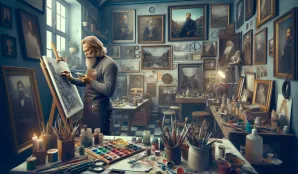
Artist salary
Latest available salary statistics are for 2025. Compare average pay, salary range and related job listings.
43 692 - 41 986 SEK / month
Kultur, media, design
Related tools
Salary progression Artist
What does an artist do? – Tasks and work environment
An artist works with creating visual expressions through painting, sculpture, graphics, illustration, or digital media. Tasks often include idea development, material selection, the creation process, and exhibition planning. Many artists combine their own creation with assignments, teaching, or project management within the art field. The work environment varies from personal studios and workshops to public spaces, schools, or cultural institutions. The profession is often characterized by a high degree of independence and self-management.
Salary development over time
The salary for artists has steadily increased over the past three years. In 2022, the average salary was 36,200 SEK per month, which increased to 39 779 SEK in 2023. During 2024, the average salary has risen further to 41 986 SEK per month. This represents a total increase of about 10% over the period. The positive trend can be explained by increased demand for cultural services, more public projects, and a growing interest in art in society. However, the market for artists remains competitive, and salary development may vary between different specializations and regions.
Artist salary – complete overview
- Average salary: 41 986 SEK/month
- Lowest/Highest salary: Data unavailable
- Hourly wage: 239 SEK
- Gender differences: Data unavailable
- Regional differences: Data unavailable
Education and qualifications
To work as an artist, a higher education in art from university or folk high school is usually required, but many combine formal education with self-study and practical experience. Creative ability, technical skills, and perseverance are crucial qualities for success in the profession. Building a network and portfolio is also common to establish oneself in the job market.
- Artistic higher education: 3–5 years (e.g., Konstfack, HDK-Valand, or Umeå Academy of Fine Arts)
- Folk high school education: 1–2 years, often as preparation for higher studies
- Courses and workshops: In various techniques, materials, and digital tools
- Internships and projects: Experience from exhibitions, collaborations, and personal projects is meritorious
- Self-study and portfolio work: Important for demonstrating breadth and skills
Many artists work interdisciplinarily and combine their creation with teaching, curating, or digital entrepreneurship. Building networks and collaborating across art forms has become increasingly important for outreach and project funding.
Common benefits and compensations
Benefits for artists vary depending on employment type and client. It is common to receive fees for exhibitions, project grants, and opportunities for stipends. When employed by folk high schools or cultural institutions, pension contributions, wellness allowances, and training may also be included. Many artists work as self-employed and are responsible for their own social benefits and insurance.
Competition and challenges
The profession as an artist is characterized by fierce competition and uncertain income, as demand for art varies over time and between regions. Establishing oneself in the market often requires long-term effort to build networks and a strong personal brand. Many artists need to combine their creative work with other tasks, such as teaching or project management, to maintain a stable income. Funding for personal projects and access to exhibition opportunities can also be challenging. At the same time, the profession offers great freedom and opportunities for personal development.
Tips for aspiring artists
To succeed as an artist, it is good to be persistent and brave to develop your own style and expression. Strong drive and creativity facilitate the development of new ideas and finding your place in the market. Being social and building networks is crucial for exhibitions and collaborations, while self-discipline helps drive projects to completion. Flexibility and openness to new techniques and work methods make it easier to adapt to changes in the industry. Finally, patience is important, as establishing oneself can take time and the road to success is often long-term.
Key facts about Artist
- Education level: Artistic higher education (3–5 years) most common
- Work environment: Own studio, workshop, or project-based
- Employment form: Self-employed or project employment most common
- Available jobs: 620 within the visual artists profession
- Profession group: Visual artists, etc.
Career paths and future prospects
After three to five years in the profession, an artist may have established themselves through exhibitions, collaborations, or teaching assignments. Many choose to broaden their activities, for example within digital art, public art, or art education. According to the Swedish Public Employment Service, no specific forecast exists for artists, but a total of 620 available jobs have been registered within the visual artists group. The industry is characterized by project-based employment and a wide range of opportunities, where networking and specialization can increase the chances of long-term livelihood.
Frequently asked questions about Artist
- What is the average salary of an artist?
- An artist has an average salary of 41 986 SEK per month. - How has the salary development for artists been?
- The salary has increased from 36,200 SEK in 2022 to 41 986 SEK in 2024, which corresponds to approximately 10% over three years. - What education is required to become an artist?
- Typically, a higher education in art lasting 3–5 years is required, but also folk high school and self-study are common. - What is the job market like for artists?
- There are 620 available jobs within the profession, but competition is high and the job market varies. - What tasks does an artist have?
- Tasks include creating artworks, planning exhibitions, project management, and sometimes teaching. - Are there regional salary differences for artists?
- No available data on regional salary differences for artists. - Do artists often work as self-employed?
- Yes, many artists run their own businesses or work project-based.

Salary distributed by age and sector

About the data
All information displayed on this page is based on data from the Swedish Central Bureau of Statistics (SCB), the Swedish Tax Agency and the Swedish employment agency. Learn more about our data and data sources here.
All figures are gross salaries, meaning salaries before tax. The average salary, or mean salary, is calculated by adding up the total salary for all individuals within the profession and dividing it by the number of individuals. For specific job categories, we have also considered various criteria such as experience and education.
Profession Artist has the SSYK code 2651, which we use to match against the SCB database to obtain the latest salary statistics.

Compare salary, work tasks and job outlook in adjacent occupations to find roles with similar skills or pay levels.
-

Average salary: 41 986 SEK/month • Kultur, media, design
Choreographers and dancers
Compare with Artist
Tue, 14 Jul 2026 - 21:17 -

Accompaniment, popular music salary
Average salary: 47 400 SEK/month • Kultur, media, design
Musicians, singers and composers
Compare with Artist
Tue, 14 Jul 2026 - 13:06 -

Average salary: 47 400 SEK/month • Kultur, media, design
Musicians, singers and composers
Compare with Artist
Tue, 14 Jul 2026 - 16:17 -

Interior consultant, other salary
Average salary: 39 900 SEK/month • Kultur, media, design
Interior designers, decorators and scenographers etc.
Compare with Artist
Tue, 14 Jul 2026 - 20:19 -

Average salary: 41 400 SEK/month • Kultur, media, design
Museum curators etc.
Compare with Artist
Tue, 14 Jul 2026 - 17:55 -

Average salary: 41 986 SEK/month • Kultur, media, design
Choreographers and dancers
Compare with Artist
Tue, 14 Jul 2026 - 21:18


