- Salary statistics
- Jeweler salary
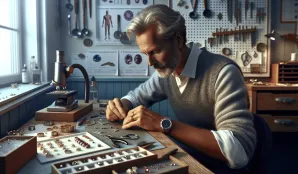
Jeweler salary
Latest available salary statistics are for 2025. Compare average pay, salary range and related job listings.
36 607 - 36 738 SEK / month
Hantverksyrken
Related tools
Salary progression Jeweler
What does a jeweler do? – Tasks and work environment
A jeweler works with designing, manufacturing, and repairing jewelry made of precious metals and stones. The work involves both manual craftsmanship and the use of specialized tools, with precision and attention to detail at the core. Common tasks include creating custom jewelry, engraving, making repairs, and assessing the authenticity and value of gemstones and metals. The work environment is often a workshop or studio, where the jeweler may work independently or as part of a small team, for example in a jewelry store. Close contact with customers to discuss design and execution of individual pieces is also common.
Salary development over time
The salary development for jewelers has been relatively stable over the past three years. In 2022, the average salary was 34,382 kronor per month, which increased slightly to 34 807 kronor in 2023. In 2024, the average salary rose further to 36 738. Overall, this represents an increase of about 1.2% over the three-year period. The slow salary growth reflects a market with relatively constant demand and stable competition for positions, while the profession requires high specialization and experience. Factors such as material costs and access to trained labor also influence salary levels, but no significant salary boom has been observed.
Jeweler salary – complete overview
- Average salary: 36 738 kr/month
- Lowest/Highest salary: Data unavailable for exact ranges
- Hourly wage: 209 kr/hour (based on 166 hours/month)
- Gender differences: Specific data unavailable
- Regional differences: Data not available
Education and qualifications
To become a jeweler, a combination of craftsmanship education and practical experience is usually required. The profession can be accessed through vocational training in crafts (goldsmithing and silversmithing), but many choose to pursue additional training, specialized courses, and apprenticeships. Practical training is crucial, and many employers value documented experience in jewelry making and repairs.
- High school education: Crafts program, specialization in goldsmithing and silversmithing (3 years)
- Higher vocational education: Specialized courses in jewelry design and manufacturing (1–2 years)
- Apprenticeships/practical training: Gaining experience with established jewelers increases employability
- Courses and certificates: Advanced courses in gemstone knowledge, engraving, or CAD design
- Prerequisites: Good manual skills, precision, and artistic sense
Many jewelers also work on custom orders where they design unique jewelry from scratch together with the customer. The creative collaboration between craftsman and client makes each project a personal story – a challenge that attracts many to the profession.
Common benefits and compensations
Jewellers are often offered benefits such as flexible working hours, opportunities for further training, and sometimes discounts on materials for personal projects. In some cases, bonuses or commissions may be offered for sales of self-made jewelry. Employment conditions vary depending on whether the business is a shop, workshop, or self-employed.
Competition and challenges
The job market for jewelers is limited, and competition for permanent positions can be tough, especially in larger cities. Many choose to start their own business to establish a foothold in the market. Challenges include high material costs, the need for continuous skill development, and keeping up with trends in jewelry design. Digitalization and e-commerce have changed sales channels, requiring new skills in marketing and customer relations. At the same time, there are opportunities for those who can offer unique, handcrafted products and personalized service.
Tips for aspiring jewelers
To succeed as a jeweler, it is good to combine accuracy with creativity and patience. A keen eye for detail helps with precision work and makes it easier to deliver high quality. Being attentive to customer wishes and able to communicate ideas is important for creating jewelry that meets expectations. Drive and self-discipline facilitate entrepreneurship or long-term projects, while curiosity about new techniques and materials provides a competitive edge. Actively seeking internships and building a network within the industry strengthens both craftsmanship skills and employment opportunities.
Key facts about jewelers
- Educational level: High school and vocational training
- Typical work environment: Workshop or studio, sometimes retail environment
- Work form: Self-employed or employed at jewelry stores/goldsmiths
- Demand: 341 available jobs in the trade group of goldsmiths and silversmiths
- Special skills: Jewelry design, gemstone assessment, precision work
Career paths and future prospects
After three to five years as a jeweler, many develop their own niche, such as specializing in gemstone setting, jewelry design, or studio management. Entrepreneurship is common and offers greater freedom and personal development. However, the industry is characterized by a limited job market, and according to the Swedish Public Employment Service's forecast, no definitive outlook can be made due to limited data. Nonetheless, the number of available positions within the trade indicates some demand, especially for craftsmen with specialized skills and the ability to meet individual customer wishes. Technological development and new sales channels may create additional career opportunities for those who are adaptable and willing to invest in their skills.
Frequently asked questions about jewelers
- What does a jeweler earn?
- The average salary for a jeweler is 36 738 kronor per month. - How does one become a jeweler?
- Most commonly, through vocational education in craftsmanship and further training and apprenticeships with established professionals. - Are there many job opportunities for jewelers?
- Currently, there are 341 available jobs within the trade group of goldsmiths and silversmiths. - What personal qualities are needed?
- Precision, creativity, and a sense of detail are central to the profession. - Do jewelers mostly work as employees or entrepreneurs?
- Both employment and self-employment are common. - What are the future prospects?
- Due to limited data, no clear assessment can be made, but specialized knowledge is in demand. - What tasks does a jeweler perform?
- Design, manufacturing, repair, and valuation of jewelry and gemstones.

Salary distributed by age and sector

About the data
All information displayed on this page is based on data from the Swedish Central Bureau of Statistics (SCB), the Swedish Tax Agency and the Swedish employment agency. Learn more about our data and data sources here.
All figures are gross salaries, meaning salaries before tax. The average salary, or mean salary, is calculated by adding up the total salary for all individuals within the profession and dividing it by the number of individuals. For specific job categories, we have also considered various criteria such as experience and education.
Profession Jeweler has the SSYK code 7312, which we use to match against the SCB database to obtain the latest salary statistics.
-

Goldsmith at Haileys Jewelry House – Restoration & Repair
Gold and silversmiths
Wed, 13 May 2026 - 00:47



Compare salary, work tasks and job outlook in adjacent occupations to find roles with similar skills or pay levels.
-

Average salary: 33 100 SEK/month • Hantverksyrken
Tailors and atelier seamstresses etc.
Compare with Jeweler
Tue, 14 Jul 2026 - 08:16 -

Average salary: 33 100 SEK/month • Hantverksyrken
Tailors and atelier seamstresses etc.
Compare with Jeweler
Tue, 14 Jul 2026 - 11:56 -

Average salary: 34 000 SEK/month • Hantverksyrken
Musical instrument makers and other artisans
Compare with Jeweler
Tue, 14 Jul 2026 - 07:13 -

Curtain seamstress, studio salary
Average salary: 33 100 SEK/month • Hantverksyrken
Tailors and atelier seamstresses etc.
Compare with Jeweler
Tue, 14 Jul 2026 - 11:57 -

Ice cream grinder, other salary
Average salary: 34 000 SEK/month • Hantverksyrken
Musical instrument makers and other artisans
Compare with Jeweler
Tue, 14 Jul 2026 - 10:07 -

Average salary: 34 200 SEK/month • Hantverksyrken
Fine, interior and furniture carpenters
Compare with Jeweler
Tue, 14 Jul 2026 - 00:44


