- Salary statistics
- Interior saddler salary
Interior saddler salary
Latest available salary statistics are for 2025. Compare average pay, salary range and related job listings.
32 100 - 32 200 SEK / month
Hantverksyrken
Related tools
Salary progression Interior saddler
What does an interior upholsterer do? – Tasks and work environment
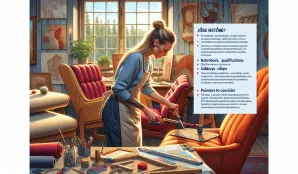
An interior upholsterer works with manufacturing, renovating, and repairing padded interior details in vehicles, such as car seats, boat interiors, and aircraft interiors. The profession also includes reupholstering furniture and creating custom solutions for various types of vehicles. Materials used are often textiles, leather, or artificial leather, and the work requires craftsmanship skills and a sense of design. The work environment varies between small workshops, larger industrial settings, and sometimes at the customer's location, where heavy lifting and working in confined spaces may occur.
Salary development over time
The salary for interior upholsterers has shown a clear positive trend over the past three years. In 2022, the average salary was 26,100 kronor per month. In 2023, it increased to 30 900 kronor, reflecting an approximate 15% raise. By 2024, the salary has continued to rise, now at 32 200 kronor per month, an increase of about 3% from the previous year. This development can be partly attributed to increased demand for skilled craftsmanship in upholstery and saddle-making, while the shortage of trained workers pushes up salary levels. Specialization within vehicle interior work and high technical competence also positively influence salary development.
Interior upholsterer salary – comprehensive overview
- Average salary: 32 200 kr/month
- Lowest/Highest salary: No current data available at the national level
- Hourly wage: 186 kr
- Gender differences: No available statistics
- Regional differences: No detailed data available
Education and qualifications
The path to becoming an interior upholsterer typically involves a vocational high school program with specialization in upholsterer or saddle maker. Advanced knowledge can also be acquired through higher vocational education or apprenticeships, where practical experience is highly valued. Many supplement their education with specialized courses in material science and vehicle interior work to meet market demands.
- High school education: Vocational program with specialization in upholsterer or saddle maker
- Higher vocational education: Specialized programs lasting 1–2 years
- Apprenticeships: Apprenticeship periods with established saddle makers
- Courses: Material science, design, and machine sewing
- Prerequisites: Interest in craftsmanship, precision, and good color and shape sense
An interior upholsterer combines traditional craftsmanship with modern technology – it is not uncommon to use CAD drawings and advanced sewing machines to create custom solutions for exclusive vehicles.
Common benefits and compensations
Typical benefits for interior upholsterers may include wellness allowances, work clothing, flexible working hours, and opportunities for further training in specialized areas. Some employers also offer bonuses for large projects or achievements, as well as travel and tool allowances when working at the customer's location.
Competition and challenges
The competition within the profession is relatively low due to the limited number of trained interior upholsterers in Sweden. Challenges mainly include staying updated on new materials and techniques, as well as meeting increasing customer demands for custom and sustainable solutions. The industry is characterized by craftsmanship where precision and quality are crucial, demanding high levels of education and experience. Digitalization and automation also influence the profession, where some tasks can be made more efficient, but the core of the work remains craftsmanship-based.
Tips for those who want to become an interior upholsterer
To succeed as an interior upholsterer, it is good to have a genuine interest in both craftsmanship and design. Attention to detail is critical, as the work often requires precision in measurement and sewing, so practicing your eye for details early is beneficial. Flexibility and problem-solving skills are important when developing custom solutions for different vehicles and customer needs. Being service-minded and communicative facilitates collaboration with both clients and colleagues, especially on larger projects. It is recommended to seek apprenticeships to build practical experience and establish valuable industry contacts. Continuously updating your knowledge of new materials and techniques makes it easier to meet future demands. Finally, patience is a key factor, as craftsmanship often requires time and care to achieve the best results.
Key facts about interior upholsterers
- Education level: High school or higher vocational education
- Work environment: Workshop, industry, or at customer locations
- Work arrangements: Full-time, part-time, or hourly employment
- Demand: 341 available jobs in the profession (May 2024)
- Special skills: Material science, machine sewing, and CAD
Career paths and future prospects
After a few years of experience, an interior upholsterer can develop into a specialist in vehicle interiors, project manager for larger interior projects, or start their own business. There are also opportunities to further education in design, material engineering, or leadership to advance in the career. Forecasts from the Employment Service indicate that it is currently difficult to provide a clear assessment of job prospects, as the profession is niche and part of a broader occupational group. Nonetheless, the 341 available jobs suggest stable demand, especially for those with specialized skills and experience.
Frequently asked questions about interior upholsterers
- What is the average salary of an interior upholsterer?
- The average salary is 32 200 kronor per month. - How do you become an interior upholsterer?
- The most common route is through a vocational program at high school, followed by apprenticeships or higher vocational education. - Where do interior upholsterers work?
- Most work in workshops, at car or boat companies, or run their own business. - Are there many job opportunities for interior upholsterers?
- The profession reports 341 available jobs in May 2024. - What qualities are needed to succeed in the profession?
- Attention to detail, patience, customer service skills, and problem-solving ability are important qualities. - Are there regional salary differences?
- There are no detailed figures on regional salary differences for the profession. - Can I further my education in the field?
- Yes, there are opportunities for further education and specialization, e.g., in design or leadership.

Salary distributed by age and sector
| Age | Base salary | Monthly salary | |
|---|---|---|---|
| Snitt | 32100 kr | 32200 kr |
| Age | Base salary | Monthly salary | |
|---|---|---|---|
| Snitt | 32100 kr | 32200 kr |
| Age | Base salary | Monthly salary | |
|---|---|---|---|
| Snitt | 32100 kr | 32200 kr |

About the data
All information displayed on this page is based on data from the Swedish Central Bureau of Statistics (SCB), the Swedish Tax Agency and the Swedish employment agency. Learn more about our data and data sources here.
All figures are gross salaries, meaning salaries before tax. The average salary, or mean salary, is calculated by adding up the total salary for all individuals within the profession and dividing it by the number of individuals. For specific job categories, we have also considered various criteria such as experience and education.
Profession Interior saddler has the SSYK code 7533, which we use to match against the SCB database to obtain the latest salary statistics.
-

Upholsterer Wanted at Sweden's Oldest Furniture Factory in Diö
Upholsterers
Mon, 29 Jun 2026 - 21:34


Compare salary, work tasks and job outlook in adjacent occupations to find roles with similar skills or pay levels.
-

Average salary: 34 000 SEK/month • Hantverksyrken
Musical instrument makers and other artisans
Compare with Interior saddler
Tue, 14 Jul 2026 - 11:44 -

Average salary: 32 802 SEK/month • Hantverksyrken
Seamstresses
Compare with Interior saddler
Sat, 11 Jul 2026 - 00:10 -
Upholsterers, furniture etc. salary
Average salary: 32 200 SEK/month • Hantverksyrken
Upholsterers
Compare with Interior saddler
Mon, 13 Jul 2026 - 05:37 -

Average salary: 40 900 SEK/month • Hantverksyrken
Precision mechanics
Compare with Interior saddler
Tue, 14 Jul 2026 - 10:05 -

Average salary: 34 200 SEK/month • Hantverksyrken
Fine, interior and furniture carpenters
Compare with Interior saddler
Sun, 12 Jul 2026 - 10:15 -

Average salary: 34 000 SEK/month • Hantverksyrken
Musical instrument makers and other artisans
Compare with Interior saddler
Tue, 14 Jul 2026 - 02:11


