News and articles
- Home
- Articles

Latest posts

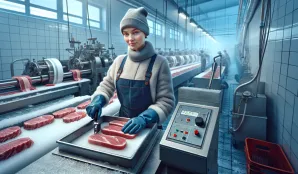
A meat processor worker in a slaughterhouse works with processing and preparing meat products immediately after slaughter. Tasks include butchering, trimming, and preparing raw materials for further processing into meat products such as sausages, ham, and other meat goods. The work is often team-based, with each member responsible for different steps in the production chain. The work environment is physically demanding and often takes place in cool environments with a fast pace, where hygiene and safety are of utmost importance. Protective equipment is regularly used to minimize the risk of injuries and to maintain food safety.
Read more ->
A charcuterie worker in manufacturing primarily works with processing and refining meat products into various cured meats, such as sausages, ham, and other delicacies. The work is often performed in industrial environments where machines and automated production lines are used to ensure high production speed and consistent quality. Tasks can include raw material handling, machine monitoring, packaging, and quality control. The environment is usually refrigerated and requires careful hygiene management, as food safety is a central part of the profession. The work is often performed in teams and may involve day and shift work, depending on the company's production needs.
Read more ->-
Opinion Polls: Kantar-Sifo shows increased support for S, decline for SD and C
Fri, 13 Feb 2026 - 01:35 -
Policy rate remains at 1.75% – Riksbank signals stability
Thu, 29 Jan 2026 - 14:02
A charcuterie worker in food sales primarily works in stores, supermarkets, or markets where meat and charcuterie products are sold over the counter. Tasks include cutting, weighing, and packaging meat, cold cuts, and sometimes cheese or ready-made food. Customer interaction is a central part of the job – advising on preparation, handling orders, and maintaining high service standards. Hygiene and food safety are very important, and work often takes place in refrigerated environments with varying hours, including weekends and evenings. The profession requires good physical condition as heavy lifting occurs, and the pace can be high, especially during holidays and promotional periods.
Read more ->
A charger in the chemical industry is responsible for monitoring and controlling processes during the manufacturing and handling of chemicals. The role involves working at large industrial facilities, preparing and loading raw materials into reactors, controlling flows, adjusting machinery, and ensuring production follows safety regulations. The work environment is typically industrial and may involve shift work, sometimes at inconvenient hours. Precision, safety awareness, and the ability to handle deviations quickly are crucial qualities in this role.
Read more ->
A mushroom grower is responsible for the entire process of mushroom cultivation, from preparing substrates and inoculating mycelium to monitoring growth and harvest. Tasks also include watering, temperature regulation, managing climate-controlled facilities, and quality control of the mushrooms. The work is often carried out in greenhouses or special cultivation rooms with high humidity and varying temperatures, where precision and patience are essential. Physical activity and irregular working hours may occur, especially during harvest periods.
Read more ->
A CEO, with managerial hierarchy, or executive director with pronounced managerial responsibility, leads and coordinates the company's overall strategies, operational goals, and results. The role involves making crucial business decisions, representing the company to the board, investors, and other stakeholders, and ensuring compliance with laws, regulations, and internal policies. The work environment is often intense, characterized by quick decisions, high pace, and many parallel responsibilities. In larger organizations, a CEO works together with a management team of other executives such as CFO, COO, and HR manager, and reports directly to the board.
Read more ->
A centrifuge operator in the chemical industry is responsible for monitoring and managing centrifuges used to separate different substances in manufacturing processes. Tasks include operating and maintaining advanced process equipment, sampling, and adjusting parameters to ensure quality and safety in production. The work is typically carried out in industrial environments with high demands on accuracy, technical knowledge, and the ability to quickly handle operational disruptions. Personal protective equipment and strict safety routines are standard, making safety awareness central to the profession.
Read more ->
A centrifuge operator in the glass industry is responsible for monitoring and controlling machines that shape and produce glass products using centrifugation techniques. Tasks include starting, stopping, and adjusting machines, inspecting raw materials, and ensuring products meet quality and dimensional standards. The operator oversees the entire process, performs ongoing checks, and carries out simple maintenance on equipment. The work environment is often industrial, which can involve high temperatures, noise, and the need for precision to ensure safety and product quality. The job requires both technical understanding and a high level of responsibility for machinery and the work environment.
Read more ->
A centerless grinder works with grinding cylindrical parts where the workpiece is not held between two centers but is supported by a guide rail and fed through the grinding tool. This method is often used in the manufacturing of components with high precision requirements, such as shafts or pipes in the industry. The work environment is typically located in workshops or industrial facilities where machines and grinding equipment are used daily. Precision, technical knowledge, and the ability to handle advanced machinery are central qualities in the role of a centerless grinder.
Read more ->
Cement grinders work with grinding, smoothing, and finishing concrete surfaces in new constructions, renovations, and large-scale projects. Their tasks often include surface preparation, grinding with specialized machines, and surface treatment to achieve the desired texture, durability, and appearance. The profession also involves quality control and sometimes measurement or documentation of work to ensure compliance with building standards and customer requirements. The work mainly takes place on construction sites, often indoors but also outdoors depending on the project. The work environment can be noisy and dusty, and heavy lifting occurs, requiring physical endurance and attention to detail.
Read more ->