News and articles
- Home
- Articles






Latest posts

A food inspector works to ensure that food businesses comply with laws and regulations regarding food safety and hygiene. The work involves regular inspections of restaurants, stores, large kitchens, and food producers to check handling, labeling, and storage of food. Reporting, advising, and sometimes training operators are part of the role. The work environment is varied, combining office work and field visits, often within municipal or government agencies, but jobs in the private sector also exist.
Read more ->
A food engineer works on developing, improving, and ensuring the quality of foods and related processes. Common tasks include product development, raw material analysis, process optimization, and ensuring that food products meet applicable legal requirements and quality standards. Food engineers are often employed in industry but can also work at research institutes, government agencies, or consulting firms. The work environment varies between laboratories, offices, and production facilities, combining practical and analytical work.
Read more ->-

Opinion Landscape: Novus February 2026 – Social Democrats Still Largest
Thu, 19 Feb 2026 - 01:35 -

Policy rate remains at 1.75% – Riksbank signals stability
Thu, 29 Jan 2026 - 14:02


A Livsmedelsbiträde primarily works in stores selling daily goods and food products. Tasks include customer service, stock picking, cash register work, and maintaining order on shelves and in storage areas. The profession often involves working at a fast pace, especially during peak hours, and managing both physical work and customer interactions. Livsmedelsbiträden are also responsible for following hygiene regulations and handling fresh products safely. Working hours can vary and often include evenings and weekends, making flexibility an important trait in the role.
Read more ->
A food worker in dairy products primarily works with the production, processing, and packaging of milk, cheese, yogurt, and other dairy-based products. Tasks often include monitoring and controlling automated production lines, quality control, cleaning and maintenance of machines, and documenting production data. The work environment is usually industrial, often with shift work and high hygiene standards. Precision, responsibility, and the ability to work both independently and in teams are required to ensure high quality and safety in production.
Read more ->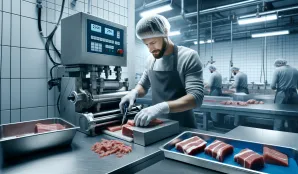
A food processing worker in meat and fish preparation is responsible for refining and processing meat and fish products on an industrial scale. Common tasks include handling raw materials, machine deboning, packaging, quality control, and supervising production lines. The work is often performed in cool and humid environments where high standards of hygiene, precision, and accuracy are required. Many tasks are physically demanding and can involve repetitive movements, but modern production facilities increasingly utilize automation to facilitate daily work.
Read more ->
A food worker in a bakery is responsible for producing bread, baked goods, and other food products on both industrial and artisanal scales. Tasks include weighing and mixing ingredients, monitoring fermentation processes, baking products, as well as packaging and quality control of finished goods. The work often takes place on production lines where machine handling is combined with manual tasks, and the work environment is characterized by a fast pace, temperature variations, and strict hygiene requirements. Shift work is common, especially in larger bakeries operating around the clock.
Read more ->
A life insurance actuary analyzes and calculates risks, sets premiums and terms for life insurance policies. The role involves advanced work with statistics, mathematical models, and actuarial calculations that form the basis for insurance companies’ offerings and pricing. Daily tasks include extensive data compilation, report writing, and advising management and authorities on actuarial issues. The work environment is typically office-based, characterized by a fast pace, tight deadlines, and collaboration within cross-functional teams.
Read more ->
A literature engineer works with managing, analyzing, and structuring large amounts of text-based material within, for example, libraries, archives, or research environments. The profession often involves responsibility for digitizing older literature, metadata management, and developing systems for information retrieval. Tasks may also include quality assurance of databases, advising researchers or the public, and educational efforts related to information literacy. The work environment is usually office-based and characterized by independent work and collaboration in project groups, often in close connection with universities, authorities, or larger organizations.
Read more ->
A literary agent acts as an intermediary between authors and publishers, responsible for negotiating contracts, selling book rights, and ensuring the best possible terms for their clients. Tasks include reading manuscripts, assessing literary quality, drafting agreements, and handling international rights sales. The role often also involves providing guidance to authors on manuscript development and marketing. The daily work environment is largely office-based but may also include travel to book fairs, publisher meetings, and industry events. Literary agents need strong legal knowledge, a broad network, and the ability to keep up with trends in the publishing industry.
Read more ->
A lithographer works with producing printing plates and originals for various forms of print production. The work includes both traditional lithographic techniques and digital prepress, where image and text originals are processed before printing. The role often involves adjusting color, format, and layout, as well as controlling print quality. The work environment is usually technically advanced and can take place in smaller print shops or larger graphic production facilities. Precision, patience, and an eye for detail are central qualities in the profession.
Read more ->