- Salary statistics
- Sculpture conservator salary
Sculpture conservator salary
Latest available salary statistics are for 2025. Compare average pay, salary range and related job listings.
43 692 - 41 986 SEK / month
Kultur, media, design
Related tools
Salary progression Sculpture conservator
What does a sculpture conservator do? – Tasks and work environment
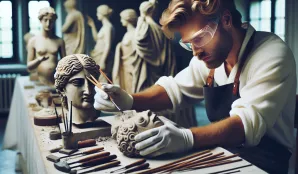
A sculpture conservator is responsible for examining, preserving, and restoring sculptures made of various materials such as stone, metal, wood, and ceramics. The tasks include both practical conservation work and documentation, where careful analysis and selection of appropriate methods are essential. Sculpture conservators often collaborate with museums, art institutions, and private collections. The work environment can range from laboratories and workshops to public spaces where artworks are displayed. The job requires high precision, patience, and a deep understanding of both artistic and scientific aspects.
Salary development over time
The salary trend for sculpture conservators has been positive in recent years. In 2022, the average salary was 36,200 SEK per month, increasing to 39 779 SEK in 2023. The latest recorded average salary for 2024 is 41 986 SEK, representing an increase of approximately 10% over a three-year period. This trend can largely be explained by increased demand for qualified conservation services and a growing interest in cultural heritage and preservation. The educational level in the profession is generally high, which also contributes to gradual salary increases. At the same time, the profession is relatively small, which can influence salary formation due to competition for the most sought-after positions.
Conservator salary – comprehensive overview
- Average salary: 41 986 SEK/month
- Lowest/highest salary: Data not available
- Hourly wage: 239 SEK
- Gender differences: Data not available
- Regional differences: No specific data available
Education and qualifications
The path to becoming a sculpture conservator typically involves higher education in conservation, often with a focus on art or cultural heritage. The education combines theoretical studies on material science and conservation techniques with practical components and supervised internships. To work independently, a bachelor's or master's degree plus experience from internships or traineeships is usually required.
- Bachelor's or master's degree in conservation – 3–5 years
- Specialized courses in material science and conservation techniques
- Internship or traineeship at a museum or conservation studio
- Prerequisites: A background in science or arts is recommended
- Certifications: May be required for certain international assignments
Many sculpture conservators work closely with artists and researchers to develop new conservation methods – the profession is both creative and interdisciplinary, where innovation meets tradition in daily work.
Common benefits and compensations
Sculpture conservators are often offered benefits such as professional development, opportunities to participate in international projects and travel, and flexible working hours. Pension schemes, wellness allowances, and insurance are also common. When employed by government or municipal institutions, additional vacation days and opportunities for research or further education may be available.
Competition and challenges
The profession as a sculpture conservator is characterized by strong competition, especially for permanent positions at major museums and institutions. The number of training places is limited, meaning recent graduates often need to seek project-based employment or work as consultants. Another challenge is staying updated on new materials and methods, as the art world and conservation industry are constantly evolving. Long-term projects can involve physically and mentally demanding work environments, where patience and precision are crucial for success.
Tips for those interested in becoming a sculpture conservator
To succeed as a sculpture conservator, it is good to be curious and meticulous, as the profession requires continuous learning and high precision. Building a strong network within the museum sector and participating in internships increases chances of establishing yourself in the job market. Good collaboration skills facilitate projects involving multiple specialists, while an analytical mindset helps solve complex conservation problems. Flexibility is also a strength, as tasks vary between practical work and theoretical documentation. Patience and methodical work support long-term restoration projects, and developing a sense for art and materials provides additional advantages in the profession.
Key facts about Sculpture Conservator
- Average salary: 41 986 SEK/month
- Education level: Bachelor's or master's degree in conservation
- Work environment: Museums, studios, public spaces
- Number of job openings in the profession: 620
Career paths and future prospects
After three to five years in the profession, a sculpture conservator can advance to more specialized roles, such as project manager for larger conservation projects or supervisor for junior colleagues and interns. Some choose to deepen their research or develop new conservation methods in collaboration with universities and research institutes. Another option is to work internationally or start their own consultancy. The employment agency's forecasts for visual artists and related professions are limited, and no precise assessment is available for sculpture conservators. Nonetheless, the number of job openings indicates that demand for conservation expertise remains stable within the profession.
Frequently asked questions about Sculpture Conservator
- What does a sculpture conservator earn?
- A sculpture conservator has an average salary of 41 986 SEK per month. - What education is required to become a sculpture conservator?
- A bachelor's or master's degree in conservation, often with practical training, is most common. - What is the job market like for sculpture conservators?
- There are approximately 620 job openings in related professions, but competition for permanent positions is high. - Where do sculpture conservators work?
- Most work at museums, conservation studios, or on public art projects. - What personal qualities are important in this profession?
- Attention to detail, patience, analytical skills, and an interest in art and materials are key qualities. - Are there salary differences between regions?
- No specific data on regional salary differences for sculpture conservators is available. - Can you work internationally as a sculpture conservator?
- Yes, especially with the right certifications and language skills, international opportunities exist.

Salary distributed by age and sector

About the data
All information displayed on this page is based on data from the Swedish Central Bureau of Statistics (SCB), the Swedish Tax Agency and the Swedish employment agency. Learn more about our data and data sources here.
All figures are gross salaries, meaning salaries before tax. The average salary, or mean salary, is calculated by adding up the total salary for all individuals within the profession and dividing it by the number of individuals. For specific job categories, we have also considered various criteria such as experience and education.
Profession Sculpture conservator has the SSYK code 2651, which we use to match against the SCB database to obtain the latest salary statistics.


Compare salary, work tasks and job outlook in adjacent occupations to find roles with similar skills or pay levels.
-

Average salary: 45 500 SEK/month • Kultur, media, design
Journalists etc.
Compare with Sculpture conservator
Mon, 13 Jul 2026 - 10:06 -

Average salary: 41 400 SEK/month • Kultur, media, design
Museum curators etc.
Compare with Sculpture conservator
Sun, 12 Jul 2026 - 12:32 -
Average salary: 45 500 SEK/month • Kultur, media, design
Journalists etc.
Compare with Sculpture conservator
Fri, 10 Jul 2026 - 19:49 -
Average salary: 40 600 SEK/month • Kultur, media, design
Translators, interpreters and linguists etc.
Compare with Sculpture conservator
Tue, 14 Jul 2026 - 05:42 -

Average salary: 37 300 SEK/month • Kultur, media, design
Actors
Compare with Sculpture conservator
Mon, 13 Jul 2026 - 16:57 -

Average salary: 47 400 SEK/month • Kultur, media, design
Musicians, singers and composers
Compare with Sculpture conservator
Sun, 12 Jul 2026 - 15:38


