- Salary statistics
- Porcelain grinder salary
Porcelain grinder salary
Latest available salary statistics are for 2025. Compare average pay, salary range and related job listings.
33 800 - 34 000 SEK / month
Hantverksyrken
Related tools
Salary progression Porcelain grinder
What does a porcelain polisher do? – Tasks and working conditions
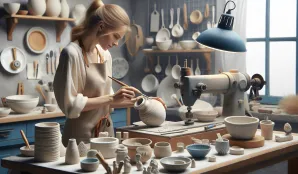
Porcelain polishers work with processing and shaping porcelain objects through grinding and polishing to give the products the desired form and surface. Tasks often include fine-tuning details, quality control, and adaptation to specific requirements from manufacturers or artists. The working environment is typically workshop-based, emphasizing precision and accuracy, with handling of grinding tools and machines being central. Porcelain polishers must have good hand-eye coordination and patience to ensure high quality in the finished work.
Salary development over time
Over the past three years, the salary for porcelain polishers has shown a downward trend. In 2022, the average was 34,382 SEK per month, which slightly decreased to 30 900 SEK in 2023, and then dropped to 34 000 SEK in 2024. This decline corresponds to approximately a 10.6 percent decrease from 2023 to 2024. A possible explanation for this development could be changes in demand within the craft sector or adjustments in the job market for musical instrument makers and similar artisans. Since the educational level and specialization are relatively high, market fluctuations may impact salaries more than in broader occupational groups. Overall, the salary trend indicates that the profession can be sensitive to economic factors and industry changes.
Porcelain polishers often need to combine technical skill with artistic sensibility, making the profession unique within the craft sector.
Porcelain polisher salary – comprehensive overview
- Average salary: 34 000 SEK/month
- Lowest/Highest salary: Data not available
- Hourly wage: 186 SEK/hour (based on 166 working hours/month)
- Gender differences: Salary data for men and women are not available
- Regional differences: Information not available
Education and qualifications
The educational path for porcelain polishers is often linked to craft programs specializing in applied arts or musical instrument making. Practical training and apprenticeship periods are common to develop the specialized skills required. Formal education can vary, but the profession generally demands good knowledge of materials and grinding techniques.
- Formal qualifications: Craft education in applied arts or musical instrument making, often 1–3 years
- Certifications/courses: Specialized courses in grinding techniques and material handling may be available
- Internship/trainee: Apprenticeships or practical training are common for gaining work experience
- Prerequisites: Basic craftsmanship skills and good hand-eye coordination
- Tips for choosing: Seek programs focusing on precision and material knowledge
Common benefits and compensations
Porcelain polishers are often offered benefits such as collective pension schemes, health insurance, and holiday pay. Many have access to flexible working hours depending on the workplace, and some may receive reimbursement for professional training or courses. Protective equipment and ergonomic aids are also typically included to facilitate the physically demanding work.
Competition and challenges
The profession of porcelain polishing is specialized and has a relatively limited job market, which can lead to competition for available positions. Challenges include staying updated with new grinding techniques and materials, as well as maintaining high precision and quality. The working environment can also be physically demanding, requiring good ergonomics and health. There is also a risk that automation in certain parts of the manufacturing process could impact demand for the profession in the future.
Tips for aspiring porcelain polishers
To succeed as a porcelain polisher, it is beneficial to develop a strong sense for detail and patience, as the profession requires precision at every stage. Accuracy is a key trait that helps deliver quality work, crucial for establishing oneself in the industry. Technical skills facilitate handling grinding machines and other tools, so practical experience should be prioritized early. A creative streak can also be useful for understanding material properties and tailoring work to unique needs. Finally, having a good work ethic and being open to learning are important, as the profession often involves continuous development of skills and knowledge.
Key facts about porcelain polishers
- Average salary: 34 000 SEK/month
- Hourly wage: 186 SEK/hour
- Occupational group: Musical instrument makers and other applied arts craftsmen
- Education level: Craft education 1–3 years
- Work environment: Workshop-based with a focus on precision
Career paths and future prospects
After gaining some years of experience as a porcelain polisher, there are opportunities to specialize in areas such as advanced grinding, quality assurance, or product development within applied arts and musical instrument making. Some may also move into educational roles or supervisory positions within craft workshops. The employment agency’s data shows approximately 341 available jobs in the field, indicating steady demand. The future outlook is considered relatively good, especially for those combining traditional craftsmanship with modern techniques and material knowledge.
Frequently asked questions about porcelain polishers
- What does a porcelain polisher earn?
- The average salary is approximately 34 000 SEK per month with an hourly wage around 186 SEK. - What education is required to become a porcelain polisher?
- A craft education of 1–3 years in applied arts or musical instrument making is common. - Are there regional differences in porcelain polisher salaries?
- There is no available information regarding regional salary differences for this profession. - What is the working environment like for a porcelain polisher?
- The work environment is workshop-based with a focus on precision and ergonomics. - Is it difficult to find a job as a porcelain polisher?
- There is steady demand with over 300 available jobs, but competition can vary.

Salary distributed by age and sector
| Age | Base salary | Monthly salary | |
|---|---|---|---|
| Snitt | 33800 kr | 34000 kr |
| Age | Base salary | Monthly salary | |
|---|---|---|---|
| Snitt | 33800 kr | 34000 kr |
| Age | Base salary | Monthly salary | |
|---|---|---|---|
| Snitt | 33800 kr | 34000 kr |

About the data
All information displayed on this page is based on data from the Swedish Central Bureau of Statistics (SCB), the Swedish Tax Agency and the Swedish employment agency. Learn more about our data and data sources here.
All figures are gross salaries, meaning salaries before tax. The average salary, or mean salary, is calculated by adding up the total salary for all individuals within the profession and dividing it by the number of individuals. For specific job categories, we have also considered various criteria such as experience and education.
Profession Porcelain grinder has the SSYK code 7319, which we use to match against the SCB database to obtain the latest salary statistics.
-

Production Staff Wanted at Svebab – Svenska Brandslangsfabriken AB
Musical instrument makers and other artisans
Fri, 10 Jul 2026 - 21:23 -

Engraver and Customer Receptionist at Vasaboden – Full-Time Temporary Position
Musical instrument makers and other artisans
Tue, 7 Jul 2026 - 09:01 -

Screen Printer for Sign Production in Tumba
Musical instrument makers and other artisans
Mon, 29 Jun 2026 - 23:45 -

Machine Operator for Glass Manufacturing in Limmared
Musical instrument makers and other artisans
Thu, 25 Jun 2026 - 22:17 -

Teacher in Wood and Metal Craft at Vasaskolan in Hedemora
Musical instrument makers and other artisans
Thu, 25 Jun 2026 - 21:44
Compare salary, work tasks and job outlook in adjacent occupations to find roles with similar skills or pay levels.
-

Average salary: 40 900 SEK/month • Hantverksyrken
Precision mechanics
Compare with Porcelain grinder
Tue, 14 Jul 2026 - 17:12 -

Average salary: 35 000 SEK/month • Hantverksyrken
Glass technicians
Compare with Porcelain grinder
Tue, 14 Jul 2026 - 19:52 -

Average salary: 34 000 SEK/month • Hantverksyrken
Musical instrument makers and other artisans
Compare with Porcelain grinder
Tue, 14 Jul 2026 - 18:48 -

Average salary: 34 000 SEK/month • Hantverksyrken
Musical instrument makers and other artisans
Compare with Porcelain grinder
Tue, 14 Jul 2026 - 17:10 -

Average salary: 38 800 SEK/month • Hantverksyrken
Blacksmiths
Compare with Porcelain grinder
Tue, 14 Jul 2026 - 11:07 -

Average salary: 34 000 SEK/month • Hantverksyrken
Musical instrument makers and other artisans
Compare with Porcelain grinder
Tue, 14 Jul 2026 - 16:17


