- Salary statistics
- Monument painter salary
Monument painter salary
Latest available salary statistics are for 2025. Compare average pay, salary range and related job listings.
43 692 - 41 986 SEK / month
Kultur, media, design
Related tools
Salary progression Monument painter
What does a monumental painter do? – Tasks and work environment
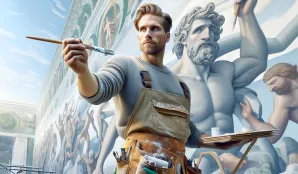
A monumental painter works with creating, restoring, and maintaining large decorative paintings and embellishments in public environments such as churches, theaters, public buildings, and historic monuments. Tasks often include both artistic design and technically advanced restoration work, requiring great precision and understanding of various materials and techniques. The work is often performed at high elevations or in buildings with special climate conditions, demanding physical endurance and meticulousness. Collaboration with architects, conservators, and other craftsmen is common, and many projects are long and complex with a focus on preserving cultural heritage.
Salary development over time
The salary for a monumental painter has shown steady and positive growth over the past three years. In 2022, the average salary was 36,200 SEK per month, increasing in 2023 to 39 779. In 2024, the average salary has risen further to 41 986 per month, representing a total increase of about 10% during this period. This development is linked to increased demand for skilled artistic craftsmen in restoration and public decoration, along with a rising educational level within the profession. The market's need for preservation efforts in cultural-historical environments also contributes to higher salary levels. The salary increase has been consistent, indicating continued stability for the profession.
Monumental painter salary – comprehensive overview
- Average salary: 41 986 SEK/month
- Lowest/Highest salary: Data unavailable
- Hourly wage (average): 239 SEK
- Gender differences: Data unavailable
- Regional differences: Data unavailable
Education and qualifications
The path to becoming a monumental painter usually involves a combination of artistic education and specialized courses in restoration and decorative painting. Practical experience, such as apprenticeships or internships, is often crucial for developing technical skills and understanding materials. Formal requirements vary depending on employers and project scope, but a high artistic level and knowledge of cultural-historical techniques are highly valued.
- Artistic higher education: 3–5 years
- Specialized courses in restoration and painting: 1–2 years
- Internship or apprenticeship: Strongly recommended
- Prerequisites: Basic artistic skills and interest in cultural heritage
- Tips for choosing: Look for programs focused on mural painting, fresco, or conservation work
Monumental painters often work in interdisciplinary teams where collaboration with architects, conservators, and heritage specialists is essential for the final result. The creative process involves preserving historical values while adding new artistic expressions. Work can vary greatly from project to project, making flexibility and problem-solving skills important qualities.
Common benefits and compensations
Many monumental painters are offered benefits such as wellness allowances, insurance, and opportunities for professional development through courses and workshops. In contract work, per diems and travel allowances may also be provided, especially if work is performed elsewhere or in special environments. Longer projects sometimes entitle workers to extra leave or compensation for unsociable hours.
Competition and challenges
The profession of a monumental painter is characterized by high competition for prestigious assignments, as the number of large public projects is limited. The work requires both artistic talent and technical skill, meaning that both recent graduates and experienced painters must continually maintain and develop their competence. Establishing oneself in the market can be challenging, especially for those working on cultural heritage objects where documentation and execution demands are high. Uncertainty about project funding and availability of public commissions also affects job opportunities within the field.
Tips for aspiring monumental painters
To succeed as a monumental painter, patience and a keen eye for detail are essential, as the work often involves long-term efforts and precision. Developing artistic skills through education and personal creation is crucial, as is curiosity and willingness to learn traditional techniques. Good collaboration skills are important, since projects are often team-based with various professional roles. An interest in cultural heritage and history adds value and helps contextualize projects. Flexibility and the ability to handle different work environments—from churches to modern public buildings—are key qualities. Finally, networking and participation in industry forums can open doors to new assignments and collaborations.
Key facts about Monumental Painters
- Education level: Higher artistic education with specialization
- Work environment: Public buildings, often at high elevations
- Work form: Project-based or consulting
- Demand: Approximately 620 job openings within the field
- Special skills: Restoration and traditional painting techniques
Career paths and future prospects
After 3–5 years in the profession, a monumental painter can take on more advanced and independent projects, often as a project leader or responsible artist in larger restorations. It is also common to combine practical work with teaching, consulting, or participating in international projects. According to the Swedish Public Employment Service's forecasts, specific predictions for monumental painters are lacking, as the profession falls under a broader group of visual artists. The absence of clear forecasts makes it difficult to predict future demand precisely, but there is a continued need for artistic expertise in preserving and developing public environments. Related professions in visual arts, mural painting, and conservation work can also be potential career paths.
Common questions about Monumental Painters
- What does a Monumental Painter earn?
- A monumental painter has an average salary of 41 986 SEK per month. - What education is required to become a monumental painter?
- Typically, artistic higher education and specialized courses in restoration and painting are required. - What is the work environment like for a monumental painter?
- Work often takes place in public buildings, at high elevations, and under varying conditions. - Are there regional salary differences within the profession?
- Available data on regional salary differences for monumental painters is lacking. - How high is the demand for monumental painters?
- There are approximately 620 job openings within the field of visual artists, including monumental painters. - What personal qualities are important for a monumental painter?
- Patience, accuracy, collaboration skills, and an interest in cultural heritage are important qualities. - What career paths are available after a few years in the profession?
- After a few years, monumental painters can take responsibility for larger projects, work as project managers, or combine the profession with teaching.

Salary distributed by age and sector

About the data
All information displayed on this page is based on data from the Swedish Central Bureau of Statistics (SCB), the Swedish Tax Agency and the Swedish employment agency. Learn more about our data and data sources here.
All figures are gross salaries, meaning salaries before tax. The average salary, or mean salary, is calculated by adding up the total salary for all individuals within the profession and dividing it by the number of individuals. For specific job categories, we have also considered various criteria such as experience and education.
Profession Monument painter has the SSYK code 2651, which we use to match against the SCB database to obtain the latest salary statistics.


Compare salary, work tasks and job outlook in adjacent occupations to find roles with similar skills or pay levels.
-

Proofreader, book publisher salary
Average salary: 42 800 SEK/month • Kultur, media, design
Authors etc.
Compare with Monument painter
Tue, 14 Jul 2026 - 01:06 -

Average salary: 44 900 SEK/month • Kultur, media, design
Graphic designers etc.
Compare with Monument painter
Mon, 13 Jul 2026 - 12:06 -

Average salary: 51 000 SEK/month • Kultur, media, design
Directors and producers of film, theater etc.
Compare with Monument painter
Mon, 13 Jul 2026 - 23:22 -

Average salary: 41 986 SEK/month • Kultur, media, design
Choreographers and dancers
Compare with Monument painter
Mon, 13 Jul 2026 - 16:44 -

Average salary: 51 000 SEK/month • Kultur, media, design
Directors and producers of film, theater etc.
Compare with Monument painter
Mon, 13 Jul 2026 - 21:32 -

Average salary: 38 500 SEK/month • Kultur, media, design
Photographers
Compare with Monument painter
Mon, 13 Jul 2026 - 23:35


