- Salary statistics
- Jewelry worker salary
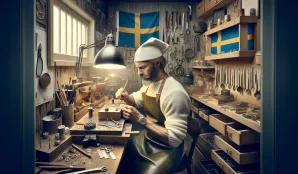
Jewelry worker salary
Latest available salary statistics are for 2025. Compare average pay, salary range and related job listings.
36 607 - 36 738 SEK / month
Hantverksyrken
Related tools
Salary progression Jewelry worker
What does a Bijouteriarbetare do? – Tasks and Work Environment
A bijouteriarbetare works with manufacturing, repairing, and sometimes designing jewelry and accessories made from simple materials such as metal, plastic, glass, or wood. Common tasks include assembling parts, welding, grinding, polishing, and quality control of finished products. The work can be performed manually or with the help of machines, depending on the size and focus of the workplace. The work environment is often workshop-based where precision and accuracy are crucial, and good fine motor skills and patience are required in daily work.
Salary development over time
The salary development for bijouteriarbetare has been relatively stable in recent years. In 2022, the average salary was 34,382 kronor per month, which increased slightly to 34 807 kronor in 2023. During 2024, the average salary has risen further to 36 738 kronor per month. The total increase over this three-year period is approximately 1.2%, indicating cautious but steady improvement. The salary trend reflects the limited but stable demand for craftsmanship in the jewelry industry, where specialized knowledge and experience are often rewarded, but the market size limits larger salary increases. The slow growth may also be due to competition from industrial manufacturing and imported goods, affecting the profession's valuation on the labor market.
Bijouteriarbetare Salary – Complete Overview
- Average salary: 36 738 kr/month
- Lowest/Highest salary: Data not available
- Hourly wage: 209 kr/hour
- Gender differences: Data not available
- Regional differences: Data not available
Education and Qualifications
To work as a bijouteriarbetare, usually no formal university education is required, but a high school education in crafts or equivalent experience is often advantageous. Many employers value practical experience and skills in fine motor work, and occupational skills are often acquired through internships, apprenticeship programs, or directly at the workplace. Specialized courses in jewelry making, material science, and design can also be beneficial to broaden competence.
- High school education: Crafts program, jewelry or metal specialization
- Internship: Workplace-based internship or apprenticeship recommended
- Courses: Short courses in jewelry making, design, and material knowledge
- Prerequisites: Precision, patience, and good fine motor skills
- Self-study: Online courses and self-training in craft techniques
Many bijouteriarbetare develop their own personal style over time and can thus create unique products that become sought after in the market. There are also opportunities to work with small-scale sales at markets or online, making the profession attractive for those who want to combine craftsmanship with entrepreneurship.
Common Benefits and Compensation
Common benefits for bijouteriarbetare include wellness allowances, subsidized work equipment, and flexible working hours depending on the employer. Some workplaces also offer discounts on their own products, as well as opportunities for skill development through internal courses and workshops. Occupational pension and insurance are often included according to collective agreements.
Competition and Challenges
The labor market for bijouteriarbetare is characterized by relatively high competition, as the profession belongs to a smaller industry with a limited number of positions. Import of cheap jewelry and accessories from abroad has also increased pressure on Swedish manufacturers, affecting employment opportunities and salary development. Craftsmanship skills and a personal creative profile can, however, be decisive in standing out in the job market. The challenges are intensified by the fact that demand for handmade bijouterie is sensitive to trends and economic cycles. Staying updated on materials and techniques is therefore important for long-term success in the profession.
Tips for those who want to become a Bijouteriarbetare
To succeed as a bijouteriarbetare, it’s good to have a creative streak and an eye for detail, as precision and form sense are crucial in the craft. Being persistent and patient allows you to learn the technical skills required to make durable and attractive jewelry. It’s wise to actively seek internships or trainee programs to quickly gain insight into the practical aspects of the profession and build valuable contacts. Curiosity helps when learning new trends or techniques, and being adaptable makes it easier to meet customers’ and employers’ changing wishes. Continuously working on self-study and seeking inspiration sources also helps develop a personal style. Finally, being meticulous and stress-resistant is an advantage, especially during periods of high production pressure.
Key facts about Bijouteriarbetare
- Education level: High school education or equivalent experience
- Work environment: Workshop or small atelier
- Occupational group: Gold and silversmiths
- Available jobs in the profession: 341
- Future prospects: No specific forecast due to limited data
Career paths and future outlook
After a few years of experience as a bijouteriarbetare, there are opportunities to advance to more independent roles, such as team leader in smaller workshops or starting one's own business in jewelry design and sales. Further education in design, marketing, or material science can open doors to specialized roles within the industry. According to the Employment Service, no specific forecast exists for the profession's future due to limited data, but the occupational group of gold and silversmiths shows a total of 341 available jobs, indicating some demand. Career development is often dependent on personal drive, networking, and the ability to find a unique niche. Many choose to combine craftsmanship with entrepreneurship or further education to meet changes in the labor market.
Frequently asked questions about Bijouteriarbetare
- What does a Bijouteriarbetare earn?
- A bijouteriarbetare has an average salary of 36 738 kronor per month. - What education is required to become a Bijouteriarbetare?
- High school education in crafts or equivalent experience is recommended. - What is the work environment like for a Bijouteriarbetare?
- The work is usually performed in a workshop setting where precision and accuracy are important. - Are there many job opportunities for a Bijouteriarbetare?
- There are 341 available jobs in the profession, but competition is high. - What personal qualities are important in this profession?
- Attention to detail, patience, and creativity are particularly important for bijouteriarbetare. - Are there salary differences between men and women?
- There is no specific information about gender differences in salary for this profession. - What are the future prospects?
- No specific forecast exists, but demand varies with economic cycles and trends.

Salary distributed by age and sector

About the data
All information displayed on this page is based on data from the Swedish Central Bureau of Statistics (SCB), the Swedish Tax Agency and the Swedish employment agency. Learn more about our data and data sources here.
All figures are gross salaries, meaning salaries before tax. The average salary, or mean salary, is calculated by adding up the total salary for all individuals within the profession and dividing it by the number of individuals. For specific job categories, we have also considered various criteria such as experience and education.
Profession Jewelry worker has the SSYK code 7312, which we use to match against the SCB database to obtain the latest salary statistics.
-

Goldsmith at Haileys Jewelry House – Restoration & Repair
Gold and silversmiths
Wed, 13 May 2026 - 00:47



Compare salary, work tasks and job outlook in adjacent occupations to find roles with similar skills or pay levels.
-

Average salary: 40 900 SEK/month • Hantverksyrken
Precision mechanics
Compare with Jewelry worker
Tue, 14 Jul 2026 - 17:12 -

Average salary: 35 000 SEK/month • Hantverksyrken
Glass technicians
Compare with Jewelry worker
Tue, 14 Jul 2026 - 19:52 -

Average salary: 34 000 SEK/month • Hantverksyrken
Musical instrument makers and other artisans
Compare with Jewelry worker
Tue, 14 Jul 2026 - 18:48 -

Average salary: 34 000 SEK/month • Hantverksyrken
Musical instrument makers and other artisans
Compare with Jewelry worker
Tue, 14 Jul 2026 - 17:10 -

Average salary: 38 800 SEK/month • Hantverksyrken
Blacksmiths
Compare with Jewelry worker
Tue, 14 Jul 2026 - 11:07 -

Average salary: 34 000 SEK/month • Hantverksyrken
Musical instrument makers and other artisans
Compare with Jewelry worker
Tue, 14 Jul 2026 - 16:17


