- Salary statistics
- Benmakare salary
Benmakare salary
Latest available salary statistics are for 2025. Compare average pay, salary range and related job listings.
33 800 - 34 000 SEK / month
Hantverksyrken
Related tools
Salary progression Benmakare
What does a Benmakare do? – Tasks and work environment
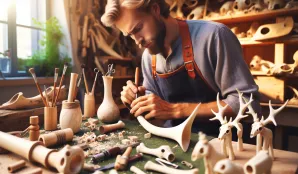
A Benmakare belongs to the professional group of musical instrument makers and other craftspeople, working with manufacturing, repairing, and restoring items made of bone, horn, or similar hard natural materials. Tasks can range from creating details for musical instruments, jewelry, or art objects, to performing advanced repairs and reconstructions. The work requires great precision, a developed sense for materials, and often an artistic eye. The environment is typically workshop-based, where the Benmakare works with both traditional and modern tools under relatively quiet and focused conditions.
Salary development over time
The salary for a Benmakare has shown some variation over the past three years. In 2022, the average salary was 34,382 SEK, increasing slightly to 30 900 SEK in 2023. However, in 2024, the average salary has decreased to 34 000 SEK, representing a decline of approximately 11% compared to the previous year. This decrease may be due to changes in demand, an increased number of recent graduates in the field, or restructuring within the crafts sector. Despite these fluctuations, the salary level remains relatively stable compared to similar crafts, but the trend underscores the importance of specialization and continuous skills development for those wishing to strengthen their position in the job market.
Benmakare salary – comprehensive overview
- Average salary: 34 000 SEK/month
- Lowest/Highest salary: Data not available
- Hourly wage: 186 SEK/hour (based on 166 hours/month)
- Gender differences: Data not available
- Regional differences: No reliable statistics available
Education and qualifications
To work as a Benmakare, a craft education focused on art crafts is usually required, often at the high school level or through specialized vocational training. Many Benmakare have also pursued higher education in art, design, or musical instrument making. Practical experience is crucial and is often gained through apprenticeships or supervised internships. Certifications and further training in material science and restoration are also valuable.
- High school education: Craft programs with a focus on art crafts (3 years)
- Vocational college: Specialized craft training, 1–2 years
- Internship/apprenticeship: Strongly recommended to build professional skills
- Courses in material science: In-depth knowledge of bone and horn
- Prerequisites: Good manual skills and interest in details
Historically, Benmakare have played an important role in preserving cultural heritage, as their craftsmanship is often used in the restoration of antique musical instruments and art objects. For those who appreciate history and tradition, the profession offers a unique opportunity to work closely with museums and cultural institutions.
Common benefits and compensations
Benmakare are often offered benefits such as flexible working hours, opportunities for self-employment, and access to specialized tools or materials through their employer. Some may also receive compensation for further training, wellness allowances, and insurance related to the work environment.
Competition and challenges
The competition in the profession of Benmakare is relatively high, as it is a niche craft with a limited number of job openings each year. Many Benmakare choose to work as self-employed, which requires both technical skill and the ability to market their services. Challenges include difficulty in finding enough assignments, price pressure from cheaper mass production, and constantly changing material requirements. Success requires ongoing skills development and networking within the crafts sector.
Tips for aspiring Benmakare
To succeed as a Benmakare, it’s good to have a combination of patience, precision, and creativity. Early internships with established craftspeople provide invaluable experience and help build professional networks. Accuracy is crucial when working with sensitive materials, so practicing fine motor skills through personal projects is recommended. Self-discipline helps manage long and sometimes monotonous tasks, and a strong desire to learn new techniques is important to stay competitive. Developing a personal style or specialization can also be a success factor. Good communication skills facilitate collaboration with clients and cultural institutions, and being open to feedback contributes to professional growth.
Key facts about Benmakare
- Education level: High school or vocational training in crafts
- Work environment: Workshop-based, often independent work
- Common employment: Self-employed or employed at specialized workshops
- Demand: 341 job openings in the profession (2024)
- Special skills: Material science, restoration, and art crafts
Career paths and future prospects
After three to five years in the profession, a Benmakare can develop into a specialist, for example in musical instrument restoration or advanced art craft manufacturing. There are also opportunities to work as a supervisor or educator within craft training programs, or to start their own business with a personal workshop. According to the Employment Service, the demand for Benmakare and related professions remains stable, with 341 job openings in 2024. The future outlook remains relatively good for those combining technical skills with entrepreneurial spirit and niche expertise.
Frequently asked questions about Benmakare
- What does a Benmakare earn?
- A Benmakare has an average salary of 34 000 SEK per month, with an hourly wage of 186 SEK. - What education is required to become a Benmakare?
- A high school education in crafts or vocational college with a focus on art crafts is recommended, often supplemented with practical experience. - What is the job market like for Benmakare?
- There are approximately 341 job openings in the profession, but competition is high and many work as self-employed. - What are the tasks of a Benmakare?
- Manufacturing, repairing, and restoring items made of bone and horn, often for musical instruments or art objects. - Are there regional salary differences for Benmakare?
- No reliable statistics are available regarding regional salary differences for the profession. - What personal qualities are important as a Benmakare?
- Patience, accuracy, creativity, and a willingness to develop are central to success.

Salary distributed by age and sector
| Age | Base salary | Monthly salary | |
|---|---|---|---|
| Snitt | 33800 kr | 34000 kr |
| Age | Base salary | Monthly salary | |
|---|---|---|---|
| Snitt | 33800 kr | 34000 kr |
| Age | Base salary | Monthly salary | |
|---|---|---|---|
| Snitt | 33800 kr | 34000 kr |

About the data
All information displayed on this page is based on data from the Swedish Central Bureau of Statistics (SCB), the Swedish Tax Agency and the Swedish employment agency. Learn more about our data and data sources here.
All figures are gross salaries, meaning salaries before tax. The average salary, or mean salary, is calculated by adding up the total salary for all individuals within the profession and dividing it by the number of individuals. For specific job categories, we have also considered various criteria such as experience and education.
Profession Benmakare has the SSYK code 7319, which we use to match against the SCB database to obtain the latest salary statistics.
-

Production Staff Wanted at Svebab – Svenska Brandslangsfabriken AB
Musical instrument makers and other artisans
Fri, 10 Jul 2026 - 21:23 -

Engraver and Customer Receptionist at Vasaboden – Full-Time Temporary Position
Musical instrument makers and other artisans
Tue, 7 Jul 2026 - 09:01 -

Screen Printer for Sign Production in Tumba
Musical instrument makers and other artisans
Mon, 29 Jun 2026 - 23:45 -

Machine Operator for Glass Manufacturing in Limmared
Musical instrument makers and other artisans
Thu, 25 Jun 2026 - 22:17 -

Teacher in Wood and Metal Craft at Vasaskolan in Hedemora
Musical instrument makers and other artisans
Thu, 25 Jun 2026 - 21:44
Compare salary, work tasks and job outlook in adjacent occupations to find roles with similar skills or pay levels.
-

Average salary: 40 900 SEK/month • Hantverksyrken
Precision mechanics
Compare with Benmakare
Tue, 14 Jul 2026 - 17:12 -

Average salary: 35 000 SEK/month • Hantverksyrken
Glass technicians
Compare with Benmakare
Tue, 14 Jul 2026 - 19:52 -

Average salary: 34 000 SEK/month • Hantverksyrken
Musical instrument makers and other artisans
Compare with Benmakare
Tue, 14 Jul 2026 - 18:48 -

Average salary: 34 000 SEK/month • Hantverksyrken
Musical instrument makers and other artisans
Compare with Benmakare
Tue, 14 Jul 2026 - 17:10 -

Average salary: 38 800 SEK/month • Hantverksyrken
Blacksmiths
Compare with Benmakare
Tue, 14 Jul 2026 - 11:07 -

Average salary: 34 000 SEK/month • Hantverksyrken
Musical instrument makers and other artisans
Compare with Benmakare
Tue, 14 Jul 2026 - 16:17


