- Articles
- General

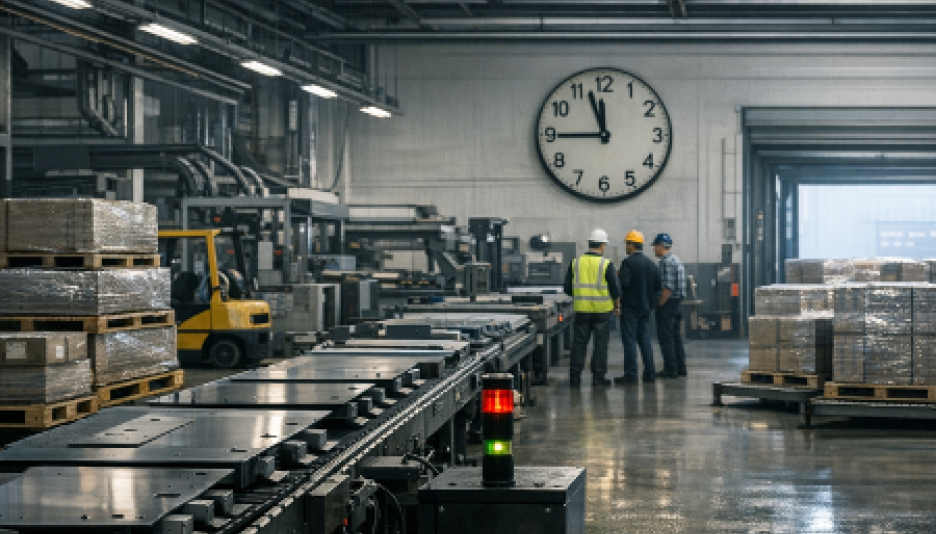

What does an unplanned production stoppage actually cost?
An unplanned production stoppage often looks like a technical fault, but the cost quickly becomes economic. Every hour of downtime affects both production and deliveries. This is particularly noticeable when margins are already squeezed. Often, the largest cost only becomes apparent a few weeks later.
Swedish industry entered 2026 with a weaker order position. Statistics Sweden (SCB) showed that industrial orders fell by 5.5 percent in January compared to December. At the same time, capacity utilization stood at 87.8 percent during the fourth quarter of 2025, meaning many companies were already operating near maximum load. This leaves less room for error.
This is because the cost does not stop at the stoppage itself. Companies also pay for scrapping and restarts, while delivery plans must be changed. Therefore, the stoppage must be read as an economic chain reaction, not as an isolated technical fault. This applies even if the stoppage lasted only a short time.
Here is where you feel the true price of the stoppage
This is especially relevant in an industry facing both weaker demand and high requirements for delivery precision. A short interruption can then eat up margins across several links in the chain simultaneously. In practice, it is about how quickly the entire chain loses rhythm. The real price tag is only visible when all consequences are added up.
When minutes turn into months
The most expensive stoppages often begin before the line actually stands still. In a widely noted Swedish battery case, untested machinery at the supplier contributed to delays of at least ten months. Problems in several areas, from testing to scaling up, tied up capital and personnel long before a formal stoppage. It is easy to underestimate such delays when the machines are running intermittently.
This shows why early control in the process is important. In many facilities, measurement is central, and different types of flow meters are used to monitor liquids and gases more accurately. This does not eliminate every risk, but it can provide an early signal when the process loses stability. Such signals can save both time and materials.
The loss of time is often almost as expensive as the stoppage itself. This cost is rarely visible on the same day. Accounting first shows lost production, and later comes the cost of troubleshooting and a sluggish restart.
- Lost production is felt directly when the machines stop.
- Waiting time increases as troubleshooting and restarts take longer.
- Recovery takes the longest when customers and suppliers have already changed plans.
When materials and energy spiral out of control
When a process is interrupted, materials and already booked logistics can quickly lose value. Weak demand does not remove vulnerability; it simply shifts where the cost is visible, according to SCB's statistics on industrial orders. In January 2026, industrial orders fell by 5.5 percent. This can pressure both cash flow and inventory.
Intermediate goods excluding energy fell by 12.3 percent simultaneously. In the chemicals and pharmaceuticals sector, the decline was 23.5 percent. This picture is reflected in SCB's statistics on industrial orders in January 2026, where the decline is broad and clear. Inventory purchased too early ties up money without generating revenue.
Energy adds its own uncertainty. The Swedish Energy Markets Inspectorate described 2025 as a year with falling wholesale prices for electricity and gas, but also significantly increased price volatility in electricity. SCB simultaneously showed that energy-related producer prices rose by 2.8 percent year-on-year in November 2025, with different parts of the electricity and heating chain driving up the level.
Therefore, costs for scrapping, energy during restarts, and rescheduled purchases and transport are often overlooked, while budgets are often based too heavily on average prices.
When customers and staff react
The next cost of the stoppage is visible among customers. In the same battery case, the downsizing was made public in May 2025, with a target to stop by June 30 of that year. By then, a major automotive customer had already prepared a switch to another supplier. The customer relationship can thus change before the downtime is even over.
This shows that stoppages rarely start in the factory and rarely end there. A single weak link can lead to late deliveries and higher unit costs. In the long run, business can be lost. This applies even if the fault initially seemed small.
Staff planning also becomes expensive when the situation swings quickly. The Institute for Business Cycle Research reported in February 2026 that manufacturing companies had reduced their number of employees more often than usual over the previous three months. The weaker sentiment increases this risk. When shifts are changed and experienced personnel leave, the restart becomes slower.
At the same time, the workforce in the battery case would be significantly reduced, showing how quickly a technical problem can become a staffing issue. With capacity utilization at 87.8 percent, there is also little room for error when something goes wrong. Both schedules and quality can be affected when the pace must change quickly. Therefore, even short stoppages are directly felt in both schedules and results.
What should be included
A realistic stoppage calculation needs to account for more than just lost production per hour. It should also include scrapping and restarts. Additionally, changed deliveries must be factored in. This provides a more accurate picture of the risk.
The smartest way to calculate is to follow the entire chain, from the first deviation to stable operations again. This reveals why a stoppage can continue to cost long after the machines have restarted. Decisions will then be better, both before and after an interruption. The most expensive hour is often the one that initially seems cheapest.











Sweden's national debt


