- Articles
- Electricity prices

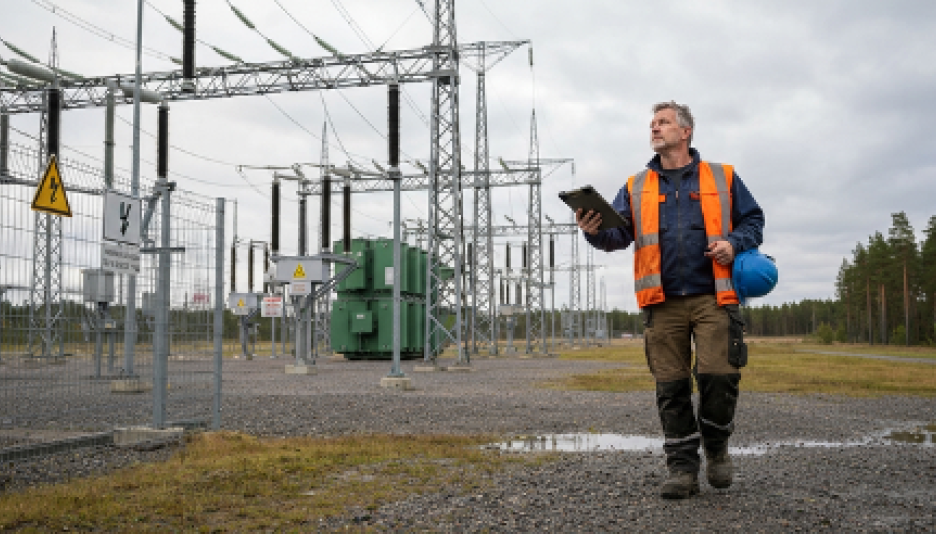

Bottlenecks in the power grid are slowing down Sweden's industrial transition
Steel, chemicals, refineries, and data centers are queuing up to connect to the Swedish power grid. The demand for electricity is already more than double what the grid can deliver on a cold winter day. Hundreds of billions of krona are tied up in one of the largest infrastructure investments in modern times. The problem does not lie in producing the electricity. It lies in transporting it.
Electricity demand is growing faster than the grid can keep up
The highest electricity consumption ever recorded in Sweden occurred on February 28, 2018. Svenska kraftnät registered a peak load of 26,700 megawatts for one hour, equivalent to 26.7 GWh. This is below the capacity limit, but not by a large margin.
According to Svenska kraftnät's grid development plan for the period leading up to 2035, the required electricity demand is already more than double today's peak hour load, which stood at 24.8 GWh for the winter of 2025/2026. This means there is a queue based on the difference between actual consumption and what customers wish to be able to consume.
To manage this queue, Svenska kraftnät outlines a ten-year construction project: approximately 2,900 kilometers of new lines and around 40 new substations. However, it is not enough to plan for construction; it must also be completed in time.
The regional grid – the critical link
Between the major transmission lines and users' fuse boxes lies a layer that rarely receives attention but often constitutes the actual bottleneck. A functioning regional grid is what allows new industry to connect within a reasonable timeframe. It transports electricity between the transmission grid and the local distribution network and can, according to the Swedish Energy Market Inspectorate (EI), be compared to our highways.
Technically, the levels differ. The transmission grid operates at 400 or 220 kilovolts. The regional grid is usually at 130 kV. The local distribution network drops to 40 kV or lower before the electricity reaches the end user. Major electricity consumers, such as industrial facilities and data centers, are often connected directly to the regional grid instead of the local network.
This is where projects often get stuck. When a new factory requires hundreds of megawatts, it is not enough for the transmission grid to have capacity. The regional line leading to it must also have capacity, which requires environmental permits, land agreements, and construction time. Permit reviews and appeals eat up time that establishment plans cannot afford to spare. The entire process takes years, not months.
Industry's queue: which establishments are waiting
Who is in the queue? In the report Industry's Electricity Demand to 2035 – A Mapping 2025, produced by SKGS (Skogsindustrierna, IKEM, Svemin, and Jernkontoret), the proportions are outlined. Industry's electricity demand is expected to increase from today's 48 TWh to between 114 and 130 TWh during the period 2025 to 2035. For some of the industries in need, the growth looks like this:
- Steel and metal plants: from 7 to 34 TWh per year
- Refineries and electrofuels: from 1 to 32 TWh per year
- Chemical industry: from 5 to 11 TWh per year
In addition to industry, data centers act as another driving force. Svenska kraftnät received withdrawal applications totaling over 9,000 MW during 2025, half of which concerned data centers.
The queue is therefore not homogeneous. It includes both long-term industrial investments with a climate profile and faster server hall projects. Svenska kraftnät also notes that several announcements of delayed industrial investments occurred in 2024, complicating planning. For a grid owner planning towards 2035, each such announcement requires a reshuffle.
The investments and their costs
There is a simple way to measure the severity: follow the money. In its grid development plan, Svenska kraftnät states that annual investments in infrastructure projects will increase from nine billion krona in 2025 to 20 billion krona per year in 2026 and 2027. This is more than a doubling in two years, in an operation where projects are already large.
The transmission grid is only part of the picture. In Sweco's Power Report 2025, commissioned by Ellevio, the scenario from their previous report, Electricity Grid Report 2023, is confirmed, regarding an investment need of 945 billion krona for all grid levels over the next 20 years. This includes both transmission, regional, and local grids.
The stated figure becomes even more serious when placed in a timeline. Already in an interview in 2023, Johan Lindehag, CEO of Ellevio, stated that the majority of investments need to be made during the next ten to twelve years. This is where it connects to state finances: an investment peak coinciding with defense buildup, interest rates, and other infrastructure investments. How the capital cost is distributed among tax payers, grid tariffs, and equity contributions is one of the questions that still lacks an answer.
The way forward for industry and the grid
On September 9, 2025, the government tasked Svenska kraftnät with developing the process for various stakeholders' connection to the transmission grid. The focus is on shorter lead times and reduced costs. The work should be carried out in collaboration with the Swedish Energy Market Inspectorate, distribution grid owners, and the Acceleration Office, and be reported by April 30, 2026. Minister of Energy and Enterprise Ebba Busch is responsible.
If the assignment succeeds, it could shorten the lead times for transmission grid connections and indirectly contribute to shorter lead times in regional grids as well. If it does not, the queue will remain long, and the discussion about financing and permit reviews will return, in a new context, when the next grid development plan is written.
{"meta":{"title":"Grid bottlenecks threaten Sweden's industrial transition","description":"Sweden's industrial transition is being slowed by bottlenecks in the power grid. Investments and faster permits are needed to meet future electricity demand."}}










Sweden's national debt


