- Salary statistics
- Toolmaker salary
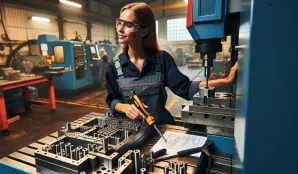
Toolmaker salary
Latest available salary statistics are for 2025. Compare average pay, salary range and related job listings.
37 300 - 37 900 SEK / month
Industriell tillverkning
Related tools
Salary progression Toolmaker
What does a toolmaker do? – Tasks and work environment
A toolmaker works with manufacturing, repairing, and maintaining advanced tools, molds, and fixtures used in industrial production processes. The profession requires high precision as tolerances are often very small, and work is performed both manually and with the help of modern CNC machines. Toolmakers are responsible for reading technical drawings, preparing work steps, and ensuring that tools meet the high quality standards required by industry. The work environment is characterized by workshops or production facilities where safety routines, order, and precision are crucial for successful results.
Salary development over time
The salary for toolmakers has shown steady growth in recent years. In 2022, the average salary was 33,500 SEK per month, increasing to 35 900 SEK in 2023. During 2024, the average salary continued to rise and is now 37 900 SEK per month, which corresponds to an increase of approximately 7.2% over three years. This development reflects a continued demand for skilled labor within the industry, especially for those with specialized competence in tool manufacturing and machine processing. The salary increase can also be attributed to an increased need for technical knowledge and digital skills, as well as a certain shortage of experienced toolmakers in the labor market.
Toolmaker salary – comprehensive overview
- Average salary: 37 900 SEK/month
- Lowest salary: Data unavailable
- Highest salary: Data unavailable
- Hourly wage: 216 SEK/hour
- Gender differences: Men 38 000 SEK, women – data unavailable
- Regional differences: Data unavailable
Education and qualifications
To work as a toolmaker, a typical requirement is a upper secondary education in industrial technology or equivalent, often followed by an apprenticeship or practical training. The profession demands strong technical understanding, mathematical skills, and the ability to work with both manual tools and computer-controlled machines. Further training and certifications may be relevant to stay updated with technological developments in the field.
- Upper secondary education: Industrial technology program (3 years)
- Apprenticeship/practical training: Usually 1–2 years after education
- Further education: Courses in CNC technology, CAD/CAM, and metrology
- Certifications: Industry-specific certificates or licenses may be required
- Prerequisites: Basic mathematics and technical interest
Toolmakers often work closely with production and play a key role in solving urgent problems or developing new solutions for more efficient manufacturing. The creative aspect of the profession makes many appreciate the variation and the opportunity to contribute to the development of new products.
Common benefits and compensation
Toolmakers are often covered by collective agreements and offered benefits such as occupational pension, insurance, wellness allowance, and opportunities for on-site training. Shift work may be required, usually with additional compensation for overtime. Other common benefits include work clothing, subsidized lunch, and sometimes bonuses linked to production results.
Competition and challenges
The competition in the labor market for toolmakers is influenced by technological developments within the industry and demand for skilled labor. Challenges include rapid technological changes, requirements for continuous training, and adapting to new production methods. At the same time, the shortage of experienced toolmakers means that those with the right skills are highly sought after. The work environment can be physically demanding and requires high precision and safety awareness, so those interested should be both technically inclined and solution-oriented.
Tips for aspiring toolmakers
To succeed as a toolmaker, it is beneficial to have a strong technical interest and to work methodically even under time pressure. Precision is a crucial trait since small mistakes can have significant consequences in tool manufacturing. Curiosity and willingness to learn new techniques and machines facilitate development in the profession, especially as digital tools become more common. Teamwork skills are also essential since the work often involves collaboration with production and development. Those with patience and an eye for detail have good opportunities to thrive and develop within the profession. Lastly, it is valuable to take initiative and suggest improvements, as innovation is an important part of the role.
Key facts about toolmakers
- Education level: Upper secondary education in industrial technology
- Work environment: Workshop/production facility
- Work arrangement: Full-time, often daytime or shift work
- Available jobs (2024): 1437 within the profession
- Special skills: CNC technology, drawing reading, metrology
Career paths and future prospects
After three to five years in the profession, there are opportunities to develop into specialists such as advanced CNC programmers, supervisors, production technicians, or quality managers. Some choose to further their education and move into technical project management or product development within the industry. The prognosis from the Employment Service indicates that there is not enough data for a detailed assessment of future prospects for toolmakers, but the large number of available jobs suggests continued demand. Those who continuously update their skills in new technologies and production methods have good chances of employment and salary growth.
Frequently asked questions about toolmakers
- What does a toolmaker earn?
- A toolmaker has an average salary of 37 900 SEK per month. - How do you become a toolmaker?
- By completing the upper secondary industrial technology program and gaining practical experience, often followed by an apprenticeship. - Are there jobs for toolmakers?
- Yes, there are 1437 available jobs in the profession right now. - What does a toolmaker do?
- Manufactures, maintains, and repairs tools, molds, and fixtures used in industry. - What benefits do toolmakers have?
- Common benefits include occupational pension, insurance, wellness allowance, and overtime compensation. - What does the future look like for toolmakers?
- No specific forecast is available, but demand is expected to be good within the industry. - Are there differences in salary between men and women?
- Men earn 38 000 SEK/month; salary statistics for women are not available.

Salary distributed by age and sector
| Age | Base salary | Monthly salary | |
|---|---|---|---|
| 25-34 | 36300 kr | 36900 kr | |
| 35-44 | 36200 kr | 36800 kr | |
| 45-54 | 37400 kr | 37800 kr | |
| 55-64 | 39000 kr | 39600 kr | |
| Snitt | 37300 kr | 37900 kr |
| Age | Base salary | Monthly salary | |
|---|---|---|---|
| 25-34 | 36300 kr | 36900 kr | |
| 35-44 | 36200 kr | 36800 kr | |
| 45-54 | 37400 kr | 37800 kr | |
| 55-64 | 39000 kr | 39600 kr | |
| Snitt | 37300 kr | 37900 kr |
| Age | Base salary | Monthly salary | |
|---|---|---|---|
| 25-34 | 36300 kr | 36900 kr | |
| 35-44 | 36200 kr | 36800 kr | |
| 45-54 | 37400 kr | 37800 kr | |
| 55-64 | 39000 kr | 39600 kr | |
| Snitt | 37300 kr | 37900 kr |
| Age | Base salary | Monthly salary | |
|---|---|---|---|
| 35-44 | 36400 kr | 37100 kr | |
| 45-54 | 37400 kr | 37800 kr | |
| 55-64 | 39100 kr | 39700 kr | |
| Snitt | 37400 kr | 38000 kr |
| Age | Base salary | Monthly salary | |
|---|---|---|---|
| 35-44 | 36400 kr | 37100 kr | |
| 45-54 | 37400 kr | 37800 kr | |
| 55-64 | 39100 kr | 39700 kr | |
| Snitt | 37400 kr | 38000 kr |
| Age | Base salary | Monthly salary | |
|---|---|---|---|
| 35-44 | 36400 kr | 37100 kr | |
| 45-54 | 37400 kr | 37800 kr | |
| 55-64 | 39100 kr | 39700 kr | |
| Snitt | 37400 kr | 38000 kr |

About the data
All information displayed on this page is based on data from the Swedish Central Bureau of Statistics (SCB), the Swedish Tax Agency and the Swedish employment agency. Learn more about our data and data sources here.
All figures are gross salaries, meaning salaries before tax. The average salary, or mean salary, is calculated by adding up the total salary for all individuals within the profession and dividing it by the number of individuals. For specific job categories, we have also considered various criteria such as experience and education.
Profession Toolmaker has the SSYK code 7222, which we use to match against the SCB database to obtain the latest salary statistics.
-

Prototype Technician at Zenvo Automotive – Build the World's Most Exclusive Hypercars
Toolmakers
Thu, 25 Jun 2026 - 00:12




Compare salary, work tasks and job outlook in adjacent occupations to find roles with similar skills or pay levels.
-

Syringe operator, rubber salary
Average salary: 33 900 SEK/month • Industriell tillverkning
Machine operators, rubber industry
Compare with Toolmaker
Tue, 14 Jul 2026 - 05:30 -

Average salary: 34 800 SEK/month • Industriell tillverkning
Machine operators, filling, packing and labeling
Compare with Toolmaker
Sun, 12 Jul 2026 - 15:16 -

Average salary: 35 700 SEK/month • Industriell tillverkning
Grinders etc.
Compare with Toolmaker
Fri, 10 Jul 2026 - 18:59 -

Lime house worker, tannery salary
Average salary: 32 200 SEK/month • Industriell tillverkning
Other machine operators, textile, leather and leather industry
Compare with Toolmaker
Tue, 14 Jul 2026 - 08:19 -

Inspectors, concrete products salary
Average salary: 37 800 SEK/month • Industriell tillverkning
Machine operators, cement, stone and concrete products
Compare with Toolmaker
Tue, 14 Jul 2026 - 09:10 -

Average salary: 36 800 SEK/month • Industriell tillverkning
Welders and gas cutters
Compare with Toolmaker
Tue, 14 Jul 2026 - 07:11


