- Salary statistics
- Sock stitching salary
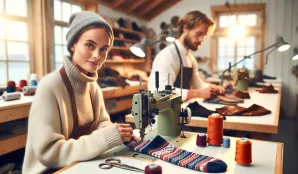
Sock stitching salary
Latest available salary statistics are for 2025. Compare average pay, salary range and related job listings.
31 300 - 34 400 SEK / month
Women earn 94% of what men do.
Industriell tillverkning
Related tools
Salary progression Sock stitching
What does a sock seamster do? – Tasks and working environment
A sock seamster works with sewing, assembling, and inspecting socks within the textile industry. The tasks mainly involve handling specialized sewing machines and monitoring production to ensure the final products meet quality standards. It often includes quality control and minor repairs of machines and equipment. The work environment is characterized by repetitive movements, working sitting or standing, and some exposure to noise and textile dust. Production pace is often dictated by machine capacity, and the workflow can be high, especially in larger factories or during peak seasons.
Wage development over time
The wage development for sock seamsters has been steadily positive over the past three years. In 2022, the average salary was 27,700 SEK per month, rising to 30 400 SEK in 2023 and further increasing to 32 200 SEK in 2024. This represents a total wage increase of approximately 9.8% over the period. This trend reflects some adjustment to inflation and general industry wage increases, but also indicates ongoing demand for experienced machine operators in the textile sector. Despite this, salary levels remain relatively low compared to other industrial professions, possibly due to competition from automation and production in low-cost countries. The gender pay gap remains around 5% in favor of men.
Sock seamster salary – comprehensive overview
- Average salary: 32 200 SEK/month
- Lowest salary: 29,400 SEK/month (female, private employee, high school education 3 years)
- Highest salary: 32,200 SEK/month (male, regional employee, high school education up to 2 years)
- Hourly wage: 183 SEK/hour
- Women earn: 31 300 SEK/month (94% of men's salary)
- Men earn: 33 200 SEK/month
- Regional differences: Highest wages are found in regional sectors, lower in private services
Education and qualifications
The path to becoming a sock seamster often involves high school education with a focus on textiles, sewing, or production technology. Formal education is usually not mandatory, but relevant high school training and experience in the textile industry or machine operation are advantageous. Many employers also offer internal training upon hiring. Practical skills in machine handling and precision are important qualities for those wishing to work as sock seamsters.
- High school education: Textiles, sewing, or industry (2–3 years)
- Internal training: Common upon employment
- Internship: Often part of education or offered via the workplace
- Prerequisites: Basic machine handling and accuracy
- Courses: Opportunities for specialization in industrial sewing
Sock seamsters often develop impressive finger dexterity and an eye for detail, enabling them to quickly spot small defects in production that might otherwise be overlooked by machines. This manual skill remains highly valued, especially in the production of specialized socks or smaller factories where flexibility is required.
Common benefits and compensations
For sock seamsters, collective agreement benefits such as occupational pension, compensation for unsocial hours, and insurance are often included. Many workplaces also offer wellness allowances, work clothing, and opportunities for skill development through further training or courses related to textile production. Shift work may occur, sometimes with additional pay.
Competition and challenges
The competition in the profession of sock seamsters is heavily influenced by automation and global competition within the textile industry. Many tasks have been streamlined or moved to countries with lower production costs, limiting the number of jobs available in Sweden. However, those with experience in modern machinery and the ability to operate multiple machines increase their employment prospects. The job also requires high precision and patience, as the work is monotonous and repetitive. The lack of formal education requirements makes entry relatively easy, but advancing to higher salary levels without specialized skills is more difficult.
Tips for those wanting to become sock seamsters
To succeed as a sock seamster, it’s beneficial to have a genuine interest in textiles and production, along with a desire to develop technical skills. Precision is crucial, as small errors can quickly lead to production stoppages or complaints—double-checking work is a good habit. Patience and perseverance are needed because tasks are often repetitive and the pace can be high during certain periods. Flexibility is also important, as tasks may vary depending on production needs and machine requirements. Being cooperative and communicative facilitates teamwork on the production line, and a willingness to learn new techniques or machines increases opportunities for advancement.
Key facts about sock seamsters
- Average salary: 32 200 SEK/month
- Gender difference: Women earn 94% of men's salary
- Education level: High school education in textiles/industry recommended
- Typical working environment: Factory or textile production, often shift work
- Available jobs in the profession: 1,437 positions (2024)
Career paths and future prospects
After three to five years as a sock seamster, there are opportunities to advance to more qualified roles such as supervisor, production coordinator, or machine maintenance specialist. Specialization in advanced machinery or work in quality control are also common steps for those seeking to develop further. According to the Employment Service’s forecast, it is difficult to make precise predictions for the sock seamster profession due to limited data, but there are a number of job openings for machine operators in the textile, leather, and skin industry. Future outlooks are affected by automation and global competition, but experience and specialized skills still offer good employment prospects in niche areas of the industry.
Frequently asked questions about sock seamsters
- What is the average salary of a sock seamster?
- The average salary is 32 200 SEK/month. - What are the highest and lowest salaries for sock seamsters?
- Highest salary is 32,200 SEK/month, lowest is 29,400 SEK/month. - How does gender affect the salary of sock seamsters?
- Women earn 94% of what men do in the profession. - What education is required to become a sock seamster?
- High school education in textiles, industry, or sewing is recommended. - What is the working environment like for sock seamsters?
- Work often occurs in a factory environment with monotonous tasks and some shifts. - Are there many job openings for sock seamsters?
- There are 1,437 available positions in the textile, leather, and skin industry. - What career opportunities exist after a few years as a sock seamster?
- Opportunities include roles as supervisor, machine specialist, or quality control.

Salary distributed by age and sector
| Age | Base salary | Monthly salary | |
|---|---|---|---|
| 25-34 | 29100 kr | 31500 kr | |
| 35-44 | 95% | 29900 kr | 31800 kr |
| 45-54 | 92% | 30900 kr | 32600 kr |
| 55-64 | 93% | 31200 kr | 33000 kr |
| Snitt | 94% | 30300 kr | 32200 kr |
| Age | Base salary | Monthly salary | |
|---|---|---|---|
| 25-34 | 29100 kr | 31500 kr | |
| 35-44 | 95% | 29900 kr | 31800 kr |
| 45-54 | 92% | 30900 kr | 32600 kr |
| 55-64 | 93% | 31200 kr | 33000 kr |
| Snitt | 94% | 30300 kr | 32200 kr |
| Age | Base salary | Monthly salary | |
|---|---|---|---|
| 25-34 | 29100 kr | 31500 kr | |
| 35-44 | 95% | 29900 kr | 31800 kr |
| 45-54 | 92% | 30900 kr | 32600 kr |
| 55-64 | 93% | 31200 kr | 33000 kr |
| Snitt | 94% | 30300 kr | 32200 kr |
| Age | Base salary | Monthly salary | |
|---|---|---|---|
| 25-34 | 29600 kr | 32500 kr | |
| 35-44 | 95% | 29800 kr | 32500 kr |
| 45-54 | 92% | 31800 kr | 34000 kr |
| 55-64 | 93% | 31700 kr | 34500 kr |
| Snitt | 94% | 30500 kr | 33200 kr |
| Age | Base salary | Monthly salary | |
|---|---|---|---|
| 25-34 | 29600 kr | 32500 kr | |
| 35-44 | 95% | 29800 kr | 32500 kr |
| 45-54 | 92% | 31800 kr | 34000 kr |
| 55-64 | 93% | 31700 kr | 34500 kr |
| Snitt | 94% | 30500 kr | 33200 kr |
| Age | Base salary | Monthly salary | |
|---|---|---|---|
| 25-34 | 29600 kr | 32500 kr | |
| 35-44 | 95% | 29800 kr | 32500 kr |
| 45-54 | 92% | 31800 kr | 34000 kr |
| 55-64 | 93% | 31700 kr | 34500 kr |
| Snitt | 94% | 30500 kr | 33200 kr |
| Age | Base salary | Monthly salary | |
|---|---|---|---|
| 35-44 | 95% | 30000 kr | 30900 kr |
| 45-54 | 92% | 30200 kr | 31400 kr |
| 55-64 | 93% | 30900 kr | 32000 kr |
| Snitt | 94% | 30000 kr | 31300 kr |
| Age | Base salary | Monthly salary | |
|---|---|---|---|
| 35-44 | 95% | 30000 kr | 30900 kr |
| 45-54 | 92% | 30200 kr | 31400 kr |
| 55-64 | 93% | 30900 kr | 32000 kr |
| Snitt | 94% | 30000 kr | 31300 kr |
| Age | Base salary | Monthly salary | |
|---|---|---|---|
| 35-44 | 95% | 30000 kr | 30900 kr |
| 45-54 | 92% | 30200 kr | 31400 kr |
| 55-64 | 93% | 30900 kr | 32000 kr |
| Snitt | 94% | 30000 kr | 31300 kr |

About the data
All information displayed on this page is based on data from the Swedish Central Bureau of Statistics (SCB), the Swedish Tax Agency and the Swedish employment agency. Learn more about our data and data sources here.
All figures are gross salaries, meaning salaries before tax. The average salary, or mean salary, is calculated by adding up the total salary for all individuals within the profession and dividing it by the number of individuals. For specific job categories, we have also considered various criteria such as experience and education.
Profession Sock stitching has the SSYK code 8159, which we use to match against the SCB database to obtain the latest salary statistics.
-

Machine Operator at Nordifa in Halmstad
Other machine operators, textile, leather and leather industry
Wed, 8 Jul 2026 - 06:22 -

Industrial Seamstress for Germa in Kristianstad
Other machine operators, textile, leather and leather industry
Tue, 7 Jul 2026 - 21:42 -

Sewer/Seamstress for NHC in Umeå
Other machine operators, textile, leather and leather industry
Mon, 6 Jul 2026 - 21:26 -
Sewer/Seamstress for NHC in Timrå
Other machine operators, textile, leather and leather industry
Mon, 6 Jul 2026 - 17:06 -
Process Operator at TreeToTextile – Develop the Next Generation of Sustainable Textile Fiber
Other machine operators, textile, leather and leather industry
Thu, 2 Jul 2026 - 00:37
Compare salary, work tasks and job outlook in adjacent occupations to find roles with similar skills or pay levels.
-
Average salary: 33 700 SEK/month • Industriell tillverkning
Other machine operators, food industry etc.
Compare with Sock stitching
Tue, 14 Jul 2026 - 11:56 -

Average salary: 37 800 SEK/month • Industriell tillverkning
Machine operators, cement, stone and concrete products
Compare with Sock stitching
Mon, 13 Jul 2026 - 10:26 -

Average salary: 42 500 SEK/month • Industriell tillverkning
Process operators, paper
Compare with Sock stitching
Tue, 14 Jul 2026 - 08:16 -
Wallpaper roller engravers salary
Average salary: 35 300 SEK/month • Industriell tillverkning
Prepress technicians
Compare with Sock stitching
Tue, 14 Jul 2026 - 11:05 -

Average salary: 36 900 SEK/month • Industriell tillverkning
Other process and machine operators
Compare with Sock stitching
Tue, 14 Jul 2026 - 13:04 -

Hasplare, textile industry salary
Average salary: 32 200 SEK/month • Industriell tillverkning
Other machine operators, textile, leather and leather industry
Compare with Sock stitching
Tue, 14 Jul 2026 - 11:54


